


Treasures for the Public, Souls Cast in Stone: The Unselfish Legacy of Haipai Scholar’s Rock Master Zhong Lingqiang and the "Pi Shi Zhai" Collection

By OGP Reporters / Members Contribute File Photos

Oh Good Party
Yet, the public sees only the record-breaking gavel strikes at auctions or the illuminated display cases in museums; few truly comprehend the arduous hardship and deep solitude a collector endures over decades. True collecting is never an effortless financial game. It is an ultimate trial of vision, financial resources, scholarship, courage, and fate. The greater significance of collecting lies in leaving an observable cultural memory for society and future generations.
In the vast expanse of geological epochs, a stone requires hundreds of millions of years of relentless weathering and cataclysmic tectonic shifts before it can engrave the rugged, majestic bones of nature’s creation. Similarly, amidst the vicissitudes of human connoisseurship, the emergence of a true collector demands half a lifetime of devotion, immense financial sacrifice, and refined wisdom to discover and nurture every single artifact.
From early days spent wandering mountain passes and river valleys, seeking specimens against all odds and exhausting personal means to acquire them, to engaging in scholarly discourse with fellow connoisseurs, publishing landmark texts, and curating major exhibitions that elevated scholar’s rocks to an art form—a collector’s life is a race against time, a sacred calling to safeguard the living soul of nature’s craftsmanship. Yet, when a collection culminates into a summit over decades of quiet accumulation, a truly great collector faces the most difficult, yet most noble, decision at the apex of life: should these lifetime treasures remain locked away in private quarters for personal heirlooms, or should this monumental beauty be unconditionally gifted to society?
On the morning of September 28, 2026, the exhibition "Millennia Recorded in Stone, A Century Anchored in Integrity: Special Exhibition of Zhong Lingqiang’s Haipai Scholar’s Rock Art" officially opened at the China Accounting Museum. This event is not merely a grand festival of Haipai scholar’s rock art; it is a profound testament to a master collector’s lifetime of gathering and relinquishing—a timeless answer offered to society on integrity, devotion, and cultural transmission.


Section I | Millennia Recorded in Stone: A Covenant of Nature and Spiritual Anchorage Across Epochs
Geology reveals that the formation of every scholar’s rock is the quiet, unspoken settling of time across hundreds of millions of years in total darkness. The violent compression of the Earth's crust, the scalding surges of volcanic eruptions, the endless erosion of rivers and oceans, and the ceaseless carving of wind and sand—nature uses time as its brush and water and fire as its ink, solidifying the prehistoric transformations of sea and land into the crisscrossing textures and proud, unyielding bones that stand before us today.
Appreciating stones—historically termed sou shi (searching for stones) or nong shi (attending to stones)—has never been a simple pastime. It represents the deepest expression of spirit and moral aspiration within the intellectual landscape of Chinese scholars.
When a selection of Haipai scholar’s rocks, imbued with the divine resonance of heaven and earth, steps into the campus of Lixin as it approaches its centenary celebration, what they stir is far more than an ordinary art exhibition. It is a covenant of nature spanning tens of millions of years, a profound dialogue touching upon cultural lineage and spiritual character.
On the morning of September 28, 2026, a pristine ambiance filled the grand halls of the China Accounting Museum at the Wenxiang Road Campus of Shanghai Lixin University of Accounting and Finance. The opening ceremony of "Millennia Recorded in Stone, A Century Anchored in Integrity: Special Exhibition of Zhong Lingqiang’s Haipai Scholar’s Rock Art" commenced amidst great solemnity and joy.
As another major intangible cultural heritage showcase organized by the Cultural Heritage and Museum Center following the Zisha Art Special Exhibition earlier this year, this exhibition demonstrates not only the natural wonders of creation, but also the inner spiritual grain of Haipai scholar’s rock culture—characterized by all-embracing openness and refined elegance.
At the opening ceremony, as the red silk velvet gently glided off, magnificent rocks of varying postures and infinite spirit stood quietly before the audience. Some resembled towering mountains and flowing waters, evoking the atmospheric resonance and subtle white spaces of Song Dynasty landscape paintings; others sat like mythical beasts, their surface grains subtly flowing with the ancient clouds of primeval times; still others presented dreamlike natural images through unique graphic patterns. Every rock was a silent, soul-stirring epic of nature.
Distinguished scholars and experts from the museum and scholar’s rock communities gathered at the venue, visibly moved by this "bookless library of stone."
Dong Jinping, former Party Secretary of Shanghai Lixin University of Accounting; Yu Ying, scholar of stone culture; Yan Rui, Director of the Cultural Heritage and Museum Center; and the central protagonist of the exhibition, Haipai master collector Zhong Lingqiang, jointly witnessed this historic moment. Renowned Haipai scholar’s rock expert Zhao Deqi traced Zhong Lingqiang’s arduous, pioneering contributions as the founding Secretary-General of the Shanghai Viewing Stone Association over several decades. He noted with deep emotion that the steadfast, unpretentious, truthful, and trustworthy nature of scholar’s rocks resonates in profound spiritual harmony with Lixin’s motto: "Establish oneself through integrity."
Professor Yang Zhijie, Director of the Shaoxing China Accounting Museum, and Niu Peiyuan, President of Lixin Accounting Press, also offered heartfelt congratulations from the perspective of cultural dissemination and heritage continuity. They emphasized that integrity is the supreme virtue under heaven, and the unadorned purity inherent in stone culture serves as the finest vessel for aesthetic education and silent moral cultivation. Former Deputy Party Secretary Zhu Jianqiang and other distinguished guests also praised this grand union of nature and humanities.
Following the opening ceremony, guests and student representatives slowly entered the exhibition hall. Under soft spotlights, where stone shadows intertwined with the subtle fragrance of ink, visitors lingered before the rocks in quiet contemplation, absorbing the mystery of divine creation and the serene dignity of intangible heritage.
Yet, the most breathtaking movement of this exhibition was hidden in a monumental promise beyond the gallery walls.
This exhibition is by no means merely a temporary one-year showcase; it is a noble act destined to be etched into the histories of both Lixin and the Chinese scholar’s rock community: upon the conclusion of the one-year special exhibition, Mr. Zhong Lingqiang will donate all featured masterpieces unconditionally to the university to build a unique, refined, artistic, and scientific Haipai Scholar’s Rock Art Museum.
Private treasures become public heritage; solitary joy transforms into shared celebration.
For a master collector who has poured half a lifetime of effort, financial resources, and deep emotion into the pursuit and protection of scholar’s rocks, entrusting a lifetime’s collection to a university is no fleeting impulse. It is the most profound decision of a cultural seeker at the summit of life. From temporary display to permanent preservation, from personal prized possessions to an enduring vessel of aesthetic education on campus, Mr. Zhong Lingqiang’s rock-solid devotion has provided a perfect and honorable final home for these stones that have journeyed through hundreds of millions of years.
Stones, though speechless, touch the heart most deeply; integrity, anchored in righteousness, endures through time. This covenant of nature not only brings the divine elegance of creation to centenary Lixin, but also erects a silent yet everlasting humanistic monument across the green campus.


Section II | Half a Lifetime Devoted to Stone: Zhong Lingqiang and His Affinity with Haipai Connoisseurship
When discussing Haipai scholar’s rocks, Mr. Zhong Lingqiang is a figure that cannot be overlooked.
Born in the ancient capital of Nanjing in 1949, he settled in Shanghai with his parents at the age of eight. Having served as the Secretary-General of the Shanghai Viewing Stone Association for several consecutive terms, he currently serves as Senior Advisor to the Graphic Stone Professional Committee of the Shanghai Viewing Stone Association, Art Advisor to the China Accounting Museum in Shanghai, and a senior member of the OGP Collectors Club. Across more than thirty years of collecting, research, and curation, he has not only stood as a monumental collector in the Haipai rock community, but also as one of the essential pioneers driving Chinese scholar’s rock art toward modernization, standardization, and international recognition.
Zhong Lingqiang’s lifelong destiny with stone traces back to his childhood memories amidst the historic alleyways of Nanjing, a city renowned across dynasties.
Gifted with an innate love for painting, he was entranced as a boy by the colorful pebbles submerged in water basins inside handicraft shops, planting the seed of spiritual stones deep in his heart. After completing his military service and returning to Shanghai, an unexpected reunion with Yuhua (Rain Flower) pebbles at the Jiangyin Road Flower and Bird Market ignited his passionate "stone addiction."
These natural agates, produced in the Luhe and Yuetang regions, have accompanied Chinese ancestors since the Neolithic Beiyinyangying culture and were celebrated in poetry by scholar-officials during the Tang and Song dynasties. Premier Zhou Enlai’s cherished bowl of Yuhua stones on his desk, the connoisseurship stories of Peking Opera master Mei Lanfang and painting master Xu Beihong, and the 1993 Ministry of Culture documentary Rain Flower Stones—translated into dozens of languages for global distribution—all bear witness to the deep humanistic heritage of this "Queen of Stones."
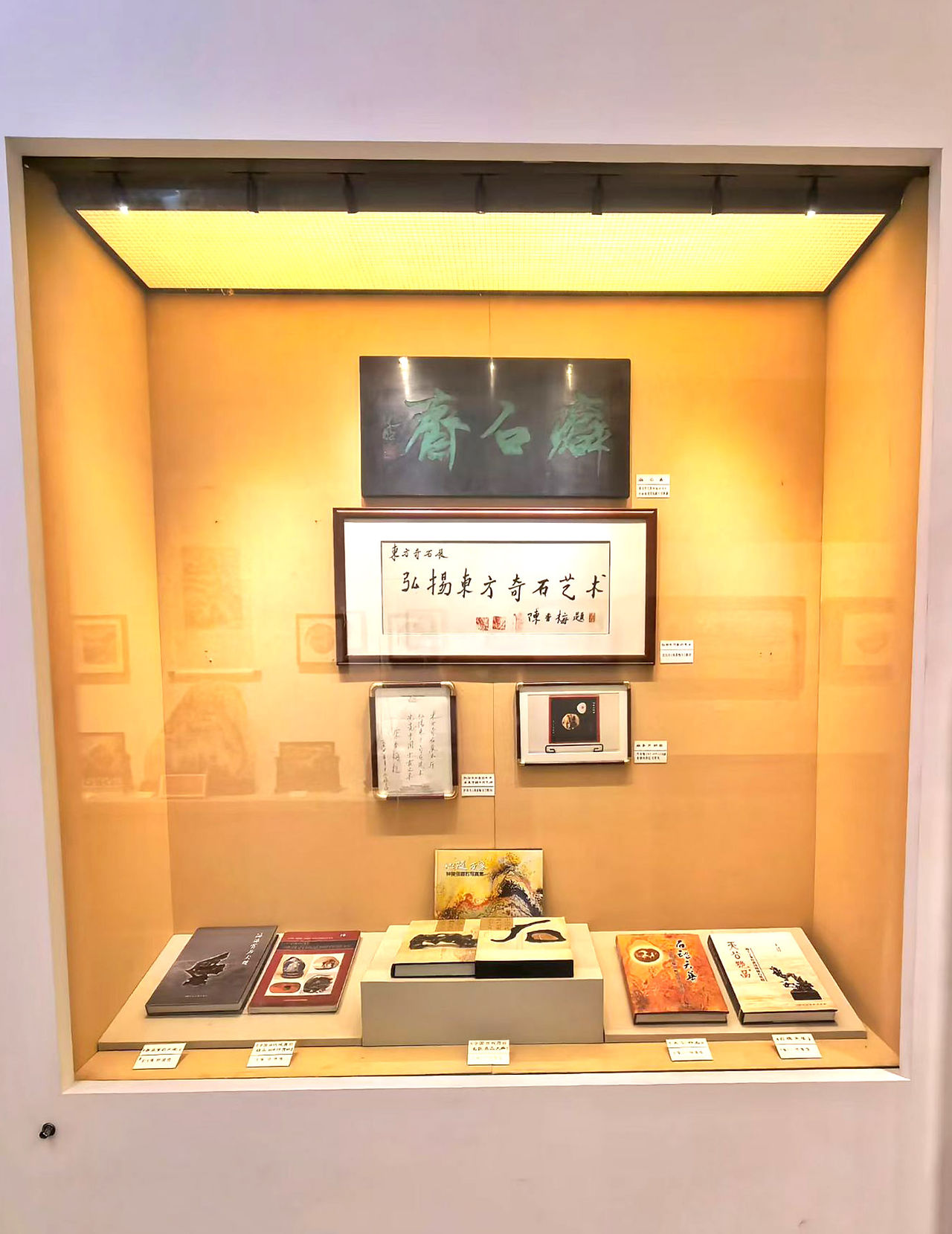
"Stones are inherently emotionless objects, yet falling into the human world, they weave bonds of affection." Beginning with the search for Yuhua stones, Zhong Lingqiang traveled by starlight and searched along rushing waters. Naming his private gallery "Pi Shi Zhai" (Studio of the Stone Addict), he gathered dozens of varieties of graphic and shaped stones over thirty years. His collection has been featured in Nature and People magazine under the column "Rare Stones at Home," and documented in authoritative reference works such as Chinese Scholar’s Rocks, Private Treasures, and Illustrated Encyclopedia of Chinese Rain Flower Stones.
Yet, within Zhong Lingqiang’s philosophy, collecting scholar’s rocks has never been an isolated indulgence behind closed doors, nor a blind capital speculation. It is a profound realization that "life is finite, but stones are infinite."
During his tenure as the founding Secretary-General of the Shanghai Viewing Stone Association, guided by the Haipai spirit of "embracing all rivers and bringing forth the new," he dedicated himself to clarifying the lineage of stone connoisseurship and building its theoretical foundation. He compiled and published major works including Compendium of Contemporary Chinese Master Collectors and Masterpieces, Appreciation of 100 Selected Masterpieces of Chinese Historical Viewing Stones, Soul of Stone, Splendor of Heaven, and Masterpieces of Nature, with his personal achievements recorded in the Dictionary of Chinese Encyclopedia Experts. Furthermore, he personally curated and organized dozens of landmark events—from the 1991 Chinese Viewing Stone Exhibition, the 1993 First Chinese Celebrity and Master Collection Exhibition, the 1994 Shanghai Oriental Rare Stone Expo, to the Hong Kong Handover Commemorative Stone Exhibition, the Shanghai Viewing Stone Annual Exhibition, the Wanchunyuan Expo, and the first Chinese Stone Market Theory Seminar.
In 1994, the prominent Chinese-American political figure Anna Chennault personally penned the inscription: "Promote the art of Oriental rare stones, illuminate the thousand-year literary splendor of China," accepting Zhong Lingqiang’s invitation to serve as Honorary Chair of the Oriental Rare Stone Expo.
With the formal inclusion of "Scholar’s Rock Art" into the National Intangible Cultural Heritage Representative List in 2014, alongside the publication of the six-volume Chinese Stone Spectrum with title calligraphy by former Premier Wen Jiabao, Chinese stone culture entered a golden age. Throughout this period, Zhong Lingqiang consistently maintained a clear, expansive international perspective.
In deep dialogues with the OGP Collectors Club, he once incisively analyzed the philosophical distinctions between Eastern and Western stone cultures:
"Influenced by the modern Industrial Revolution and scientific inquiry, Westerners favor mineral specimens and fossils, emphasizing logical analysis and natural genesis. Easterners, rooted in Confucian, Taoist, and Buddhist philosophies, prioritize artistic conception (yijing), poetic resonance, and spiritual cultivation through stone."
From early acquisitions of Chinese scholar's rocks by the Boston Museum of Fine Arts, to sculptor Richard Rosenblum astonishing Western academia with his collection of over 400 ancient Chinese stones and publishing Worlds Within Worlds, to in-depth research on "scholar’s rocks" by Harvard University and The Metropolitan Museum of Art, Zhong Lingqiang acutely recognized that Eastern and Western aesthetics were experiencing a cross-border resonance.
This vision of "entering stone with the heart to glimpse the workings of nature" is also reflected in his bond with Lixin.
Over the years, he planned the bronze bust of founding Principal Pan Xulun, participated in designing the campus Integrity Column, and fully engaged in constructing the China Accounting Museum and the Chinese Institute of Certified Public Accountants History Exhibition Hall after retirement. Inspired by the public service and selfless dedication of 89-year-old scholar Wu Haoyuan from East China Normal University, and moved by the moral atmosphere at Lixin, Zhong Lingqiang’s collecting life has consistently embodied the core principles of Haipai stone art: "Broad inclusion, ingenious composition, small-scale assembly, precise thematic naming, brilliant exhibition design, and scholarly theory."
"The world is vast, stones are ancient, and an individual is small."
As Zhong Lingqiang reflects, the Earth has an astronomical age of 4.6 billion years; stones record the memory of stars and crustal shifts, while humans are merely fleeting travelers. Appreciating stones to understand the Way is ultimately about creating infinite value within a finite lifetime. Transforming the treasures of "Pi Shi Zhai" into public heritage for the campus—allowing young scholars to comprehend heaven, earth, and integrity through stone—stands as a master collector’s most moving answer to "life is finite, but stones are infinite."


Section III | Where Should Collections Reside? Deep Reflections on Donation and Institutional Reform
"Collections gather like mountains, yet disperse like smoke." Across the history of Eastern and Western civilizations, unconditional donation to public institutions has stood as a noble choice for collectors to extend the life of artifacts and benefit society. From Zhang Boju, Wang Shixiang, and Pang Laichen donating irreplaceable national treasures to public museums, to Arthur M. Sackler and the Guggenheim family establishing public art museums in the West, these selfless acts built the landscape of shared human civilization.
Prominent Historical Donors Across Eastern and Western Civilizations:
Wang Shixiang (Renowned Chinese Cultural Heritage Expert): Unconditionally donated 79 supreme Ming and Qing dynasty furniture pieces to the Shanghai Museum during a critical historical period, forming the core of its Ming and Qing Furniture Gallery and revealing the beauty of Ming furniture to the world.
Zhang Boju (Legendary Modern Collector): Sold his family estates and risked his life during turbulent times to protect treasures, ultimately donating eight irreplaceable national treasures—including Lu Ji’s Pingfu Tie and Zhan Ziqian’s Spring Stroll—unconditionally to the Palace Museum, sustaining half of China’s premier ancient calligraphy and painting collection.
Zhang Naiqi (Prominent Patriotic Intellectual): Donated thousands of ancient Shang and Zhou bronze vessels, historical ceramics, and archaic jades unconditionally to the National Museum of China and other institutions, embodying the devotion of a patriotic scholar.
Pang Laichen (Master of "Xuzhai", Modern Collector): As the premier private collector of calligraphy and paintings in modern times, his descendants fulfilled his wishes by donating hundreds of top-tier Song, Yuan, Ming, and Qing masterworks to the Nanjing Museum and Shanghai Museum, establishing the bedrock of cultural institutions in Jiangnan.
Qian Jingtang (Giant of Haipai Calligraphy and Painting Connoisseurship): Donated thousands of rescued and cataloged historical masterpieces and Haipai works unconditionally to the Zhejiang Provincial Museum and Shanghai Museum, enriching the Jiangnan cultural lineage.
Arthur M. Sackler (American Collector and Physician): Donated tens of thousands of ancient Chinese bronzes, jades, and Asian artworks to the Smithsonian Institution and the Arthur M. Sackler Museum of Art and Archaeology at Peking University, fostering cross-cultural understanding.
Hans Heinrich Thyssen-Bornemisza (Swiss Industrialist and Collector): Donated and transferred over one thousand European master paintings collected across two generations to the Spanish state, directly creating the world-renowned Thyssen-Bornemisza National Museum.
Peggy Guggenheim (American Modern Art Patron): Rescued vast quantities of modern art amidst World War II, later donating her collection and Venetian palazzo to the Solomon R. Guggenheim Foundation, creating a sacred shrine for modern art.
Robert Ellsworth (American Dealer and Collector of Asian Art): Donated rare Ming and Qing furniture and Chinese paintings to The Metropolitan Museum of Art and other institutions, opening the doors of Eastern aesthetics to the Western world.
Charles Lang Freer (American Industrialist): Donated over 9,000 Chinese and Asian art treasures to the Smithsonian Institution, establishing the Freer Gallery of Art in Washington, D.C.
Mr. Zhong Lingqiang’s unconditional gift of his "Pi Shi Zhai" collection to Shanghai Lixin University of Accounting and Finance to establish a Haipai Scholar’s Rock Art Museum stands as a humanistic monument on campus. It also brings a profound question to the forefront of the collecting world: when collectors face advancing age, limited energy, or generational succession gaps, how should they secure the safest and most dignified final home for their treasures?
Recent crises within cultural heritage stewardship—such as the public uproar surrounding Nanjing Museum after donated works like Qiu Ying’s Spring in Jiangnan were declared "forgeries," deaccessioned, and subsequently surfaced at commercial auction houses—have exposed hidden wounds in traditional donation models, including a lack of oversight, closed archives, and the marginalization of donors’ voices.
The primary revelation of this incident for the Chinese collecting community is not merely indignation over an isolated case, but a deep systemic reflection: institutional imbalance is far more dangerous than physical damage to artifacts; an unconditional donation lacking transparent oversight and legal safeguards risks reducing a collector’s devotion to a pawn for private rent-seeking.
In this transitional era, when collectors can no longer hold their collections personally, what constitutes a wise, secure, and responsible path forward?
I. Dispelling Moral Coercion: A Balanced View on Market Circulation and "Dispersal Among the People"
For a long time, industry convention placed "unconditional donation" on an absolute moral pedestal while treating "auction and sale" as a commercial compromise. Yet, from the long-term perspective of cultural continuity, open and transparent market mechanisms (auctions, private sales) represent a healthy pathway for artworks to find new appreciative stewards and achieve secure circulation.
When artifacts change hands through reputable auction houses, buyers commit substantial capital, motivating them to invest heavily in professional conservation and scholarly research. Crucially, public transactions generate clear provenance records and title documentation, preventing artifacts from being quietly "substituted" or "evaporated" within unmonitored public storage. "Dispersing collections among the people to pass on the torch" reflects a genuine respect for the vitality of cultural heritage.
II. Establishing "Institutional Defenses": Conditional Donations and Civilian Parallel Archives
If a collector desires to transform private holdings into public heritage, traditional donation models based solely on verbal promises or letters of appreciation must be abandoned in favor of legal and institutional safeguards:
Executing Legally Binding "Conditional Donation Agreements":
Collectors must establish explicit legal boundaries—including an absolute prohibition on commercial disposal, a requirement for consent from the donor’s family or an independent academic committee for major decisions, and perpetual rights to audit archives and inspect displays. Should the receiving institution breach these terms, the donor or their heirs retain the legal right to revoke the donation and reclaim the artifacts.
Creating "Third-Party Digital Archives" and "Civilian Parallel Records":
Prior to handing over artifacts, collectors should utilize multi-spectral scanning and microscopic detail photography to generate high-definition digital archives, registering them with at least two independent academic institutions or recognized professional communities. Even if official records face future alterations, an unalterable social record remains for verification and tracking.
Prioritizing Academic and University Institutions with High Public Trust:
Compared to complex commercial museum systems, university museums and specialized research centers are anchored in educational and scholarly missions. Their archival management is more transparent, and their personnel structures remain relatively stable, making them ideal havens for specialized collections such as scholar's rocks, folk crafts, and academic archives.
III. Establishing Private/Family Museums or Charitable Trusts
For collectors with adequate financial and management capacity, establishing a private or family museum with clear property rights, or implementing modern Charitable Art Trusts—separating ownership from operational governance under an independent board and third-party oversight—represents a forward-looking approach to ensuring long-term independence and preservation.
The essence of collecting has never been permanent ownership, but a temporary stewardship.
Mr. Zhong Lingqiang’s decisive choice to donate his lifetime collection to Shanghai Lixin University of Accounting and Finance rests not only on Lixin’s century-old tradition of integrity, but also on the academic purity, transparency, and educational purpose of a university museum.
A great collector's selfless devotion deserves the most rigorous institutional protection. Only when donation shifts from blind trust to a legal covenant built on contracts, public oversight, and scholarly respect can the heart of a collector be honored, allowing China's vast cultural lineage to endure across time.


Section IV | Enduring Cultural Lineage: Guarding Infinite Stone Within a Finite Life
Within the vast horizon of human civilization, the lifespan of an artwork far outlasts that of any individual human being.
A scholar's rock formed in geological eras, a stroke of ink on Xuan paper, or a patch of patina on an ancient bronze—the time they sit in quiet darkness is measured in thousands or hundreds of millions of years. Humans are merely fleeting travelers between heaven and earth. The essence of collecting is never "permanent possession," but a temporary stewardship that uses a finite life to guard infinite time.
Yet, the public sees only the record-breaking gavel strikes at auctions or the illuminated display cases in museums; few truly comprehend the arduous hardship and deep solitude a collector endures over decades.
True collecting is never an effortless financial game. It is an ultimate trial of vision, financial resources, scholarship, courage, and fate.
To discover a soul-stirring rock or a painting with impeccable provenance, a collector travels through night and day across mountains and rivers. In eras lacking transparent information, every acquisition is a ruthless test of eye and resolve—who has not tasted the bitterness of acquiring a forgery? Who has not paid a heavy "tuition fee"?
Even more challenging is the quiet study across long years. The true threshold of collecting lies not in "buying," but in "comprehending." To master the geological genesis of a rock or the stylistic evolution of a painting school, a collector must study under the lamp like a scholar, delving into historical texts, debating with international peers, and self-funding publications and exhibitions to organize scattered fragments into systematic academic knowledge.
Exhausting financial resources and energy, what does a collector ultimately seek?
For a collector as devoted as Zhong Lingqiang, the answer lies in the pure joy of "entering stone with the heart to glimpse the workings of nature."
In an era driven by impetuous materialism, collecting offers a spiritual sanctuary beyond worldly noise. When a collector brushes dust off a stone late at night, engaging in silent dialogue with creation from a hundred million years ago or scholars from a thousand years past, physical fatigue vanishes. It is a pure vibration before cosmic beauty, a deep contemplation of universal order and the origin of life.
The greater significance of collecting lies in leaving an observable cultural memory for society and future generations.
Individual life is fragile and fleeting; personal fame and wealth fade with the wind. Yet, because of this dedicated group of guardians willing to pay a lifetime's price, silent rocks scattered in mountain valleys and cultural fragments nearly lost to war and time are rediscovered, preserved, and granted humanistic warmth and academic dignity.
Through their individual efforts, they drive anchors of civilization into the vast river of time.
As demonstrated by Zhong Lingqiang over his long journey: enjoying the process of searching, and absorbing the natural philosophy and life wisdom within scholar's rocks, is itself the greatest wealth that collecting bestows upon a life.
When he chose at the height of his life to unconditionally entrust the essence of "Pi Shi Zhai"—a collection built with half a lifetime's devotion—to Shanghai Lixin University of Accounting and Finance, his collecting elevated from a private passion to a profound public gift.
What he leaves for Lixin’s students is not merely a Scholar’s Rock Art Museum combining scientific and artistic taste, nor simply dozens of natural masterpieces showing divine creation; the most precious legacy he offers to this era is a cultural seeker's reverence for nature, dedication to scholarship, and selfless spirit of sharing a lifetime's love with the world.
"Life is finite, but stones are infinite; integrity stands for a century, and cultural lineage endures."
Stones formed over hundreds of millions of years stand silent, yet witness the transformation of oceans into mountains through the turning of time; and humanity, precisely because it possesses this noble sentiment that transcends material bounds, allows the spark of civilization to endure under the starry sky, passed down from generation to generation.


Comments