


Imperial Ambition and the Crucible of Aesthetics: International Collecting Rules and Market Hegemony of High Qing Imperial Artifacts

By OGP Reporters / Members Contribute File Photos

Oh Good Party
It was precisely due to the robust national power of the High Qing, the unceasing kiln fires of Jingdezhen, and "imperial customization" pooling the nation's wealth that these world-stunning artistic heavyweights were born. The late Qing decline and the severance of craftsmanship further underscore the unrepeatable and swan-song status of these 150-year prosperous era treasures. Although High Qing imperial artifacts constitute "blue-chip equities" in the art market, their immense financial stakes mean secondary markets and private treaty channels are fraught with sophisticated, highly concealed traps. Many readers find professional connoisseurship terminology obscure; hence, we have broken it down into an easy-to-understand "Four-Pronged Practical Defensive System" to help collectors establish a scientific and rigorous anti-pitfall framework.
In the long river of Asian art connoisseurship and international auctions, few eras evoke the enduring fascination and fierce global competition sparked by the High Qing period—the reigns of Kangxi (1662–1722), Yongzheng (1723–1735), and Qianlong (1736–1795)—a golden age spanning nearly a century and a half.
Imperial artifacts were never merely the personal aesthetic playthings of monarchs; they were the material manifestations of a nation's comprehensive financial strength, technical pinnacle, and political ambition. It was precisely because of the immense national power and overflowing state treasury of the unified High Qing dynasty that the entire nation's resources could be mobilized to forge peerless porcelains and imperial treasures.
In stark contrast, by the late Qing Dynasty, as national power waned, foreign invasions multiplied, and financial reserves dried up, the imperial kilns and the Zaobanchu (Imperial Household Department Workshops) could no longer manufacture such exquisite creations. Many supreme techniques representing the absolute limits of human craftsmanship—such as micro-carving in lacquerware, top-tier enamel formulas, and complex revolving mechanisms—were lost due to a lack of capital and institutional support. The destiny of artifacts has always been profoundly intertwined with the fate of the nation.
The palace artifacts born within this 150-year golden age represent the absolute zenith of the fusion between traditional Chinese handicraft, geological materials, Western science and technology (such as enamel painting and optical perspective introduced by Catholic missionaries), and the ultimate aesthetic vision of monarchs.
From the mid-summer to the autumn of 2026, the blockbuster exhibition Clear Rhymes: Special Exhibition of Cultural Relics from the Kangxi, Yongzheng, and Qianlong Periods at the Minhang District Museum in Shanghai gathered over 110 sets of imperial treasures from 14 top-tier cultural institutions, including the National Museum of China, the Shenyang Palace Museum, the Palace Museum of Chengde Mountain Resort, and the Capital Museum. From Kangxi's solemn balance and Yongzheng's refined subtlety to Qianlong's opulent magnificence, the exhibition clearly maps the evolutionary trajectory of 17th- to 18th-century Chinese craftsmanship.
As a seasoned Asian art collector and observer of the collecting world, this article transcends ordinary exhibition guides. Grounded in the triple dimensions of art history, handicraft physics, and secondary-market financial asset allocation, it deeply analyzes the stylistic metamorphosis of High Qing artifacts, decodes the underlying logic of their dominance across global international auction houses, and provides a rigorous, practical anti-pitfall guide for collectors aspiring to acquire high-tier Qing imperial pieces.


I. Exhibition Focus: Spatial Reconstruction of the Three Imperial Aesthetics
The brilliance of the curation at the Minhang District Museum lies in its total abandonment of dry political dynastic chronologies, opting instead for "daily utensils" and "imperial manufacturing" as mediums to present a progressive spatial expression of the three-era cultural heritage. The exhibition is divided into three core sections, perfectly mirroring the distinct personalities and ruling philosophies of the three sovereigns:
1. Examining Science and Setting Principles (The Kangxi Era): Hard-Core, Archaic, and the Fusion of North and South
As the first monarch of the prosperous era after the Qing entry into Shanhai Pass, the Kangxi Emperor pursued decades of daily imperial lectures (Jingri Rijiang), combining Neo-Confucian scholarship with a profound interest in Western natural sciences.
Soul Exhibit: Opening the exhibition line is a woodblock-printed Imperial Edict (tenth year of Kangxi) from the Liaoning Provincial Museum, bearing texts in both Han Chinese and Manchu scripts and stamped with the "Seal of Imperial Command," displaying the hard-core administrative discipline and rigorous governance of the early reign.
Aesthetic Characteristics: Artifacts of this period display a tension of "archaic simplicity and the fusion of northern and southern styles." The monumental grandeur of the northern court shook hands with the delicate sophistication of southern Jiangnan artisans, laying the foundational base for High Qing craftsmanship.
2. Appreciating Art and Harboring Refinement (The Yongzheng Era): Less is More, Scholarly Restraint, and Extreme Rigor
Though his reign lasted a mere thirteen years, the Yongzheng Emperor is widely recognized by modern art historians and elite collectors as the sovereign with the highest aesthetic taste in the Qing Dynasty. Deeply versed in Chan Buddhism and Daoism, he pursued a literati sensibility of "Less is More," exercising an almost obsessive personal intervention over the manufacturing processes of the Zaobanchu.
Soul Exhibit: A Jingdezhen kiln blue-and-white dragon Zun vessel and a Chenghua-style Doucai lotus pond dish from the Capital Museum demonstrate a sublime homage to early Ming Yongle, Xuande, and Chenghua aesthetics, yet with bodies and glazes far whiter and more lustrous, and lines executed with uncompromising precision.
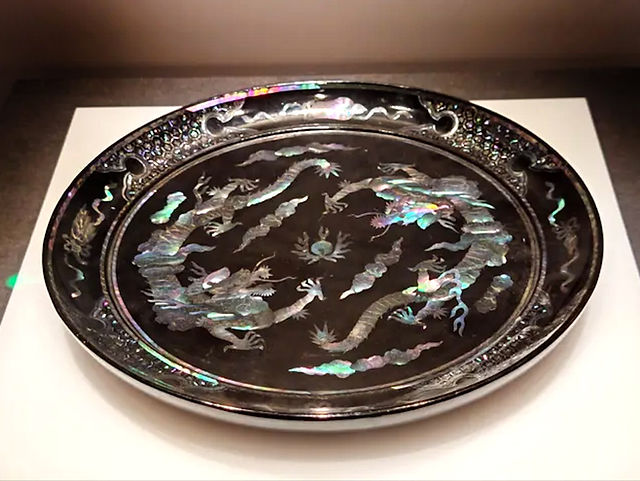
Imperial Lacquerware: A Ryukyu black lacquer inlaid mother-of-pearl double-dragon round tray from the National Museum of China showcases Yongzheng’s uncompromising demands for lacquer texture and gloss control.
3. Splendid Jade and Elegant Vessels (The Qianlong Era): Hyper-Complexity, Tenfold Craft Integration, and Imperial Omnipresence
By the Qianlong era, as national power reached its zenith, the Emperor utilized his boundless artistic energy and all-encompassing imperial ambition to push court craftsmanship into a complex extreme that "unlocked all limitations."
Soul Exhibit: The Gilt-Bronze Pine Pavilion Fruit Shield from the Shenyang Palace Museum stands as the ultimate epitome of Qing imperial haute couture—featuring an openwork pavilion structure, coiled dragon finials, pine-green enameled roof tiles, curved dragon pillars, blue enamel over gilt-bronze, and ruby-and-sapphire inlays, fusing over ten distinct manufacturing techniques including casting, filigree work, chiseling, and inlay.
A Wearable Micro-Museum: The bright-yellow silk embroidered dragon robe from the Wanshousi Museum, the gilt-silver kingfisher-feathered and gemstone-encrusted "Fengtian Gaoming" crown from the Dingzhou Museum, and the pearl-embroidered and peacock-feather court rank Buzi badges of civil and military officials elevated the peak craftsmanship of Jiangnan weaving (Nanjing, Suzhou, Hangzhou) to its absolute apex.


II. Deep Deconstruction of Stylistic Evolution and Craft Background
To comprehend the collection value of High Qing imperial artifacts, one must first understand the aesthetic metamorphosis across the personal characters, political ambitions, and manufacturing models of these three emperors. The craftsmanship of the three reigns was not isolated; it formed a clear developmental trajectory: Kangxi’s era was majestic, archaic, and robust; Yongzheng’s era was serene, refined, and minimalist; Qianlong’s era was magnificent, ornate, and hyper-complex.
1. The Kangxi Era: Majestic Gravity and the Western Fervor for Susancai
The Kangxi Emperor revived the Jingdezhen imperial kilns, which had declined due to late-Ming warfare, dispatching imperial supervisors (such as Zang Yingxuan and Lang Tingji) to oversee production. Artifacts of this period feature solid, heavy forms with upright, sturdy postures and neatly finished, weighted footrings.
Susancai (Three-Color Wares) and Tiger-Skin Glaze: Featured in the exhibition is a Susancai tiger-skin glaze bowl from the Chengde Mountain Resort Museum, glazed with mottled patches of yellow, green, and aubergine over a white ground, known as Susancai due to the absence of red. The Qing ceramic authority manual Tao Ya recorded: "Kangxi Susancai is treasured above all in Europe and America; its price is extremely high, far surpassing contemporary polychrome wares." From the late 19th to the early 20th century, Western financial titans like J.P. Morgan frantically scoured the market for Kangxi Susancai and Langyao reds at exorbitant prices, cementing their lofty status in Western mainstream collecting circles.
Langyao Red and Jihong (Sacrificial Red): Controlling copper-red glazes in high-temperature reduction kilns is notoriously difficult. The exhibited Jihong dish features a clean, restrained "lamp-grass edge" (white rim), demonstrating the Kangxi court's absolute mastery over high-temperature monochrome glazes.
2. The Yongzheng Era: A Serene Peak Rivaling Song Dynasty Aesthetics, and an Intriguing Contrast of Imperial Humor
Across the entire history of Qing and late imperial Chinese craftsmanship, Yongzheng porcelain is universally acknowledged as the sole imperial ware capable of conducting a millennium-spanning soul dialogue with the Song Dynasty porcelain peaks of Ru, Guan, Ge, and Ding.
The Yongzheng Emperor pursued exquisite line proportions and literati sentiment; wares of this reign were serene, refined, and minimalist, achieving a perfection where "one more part is vulgar, one less is deficient." The most frequent vocabulary in his edicts to the Zaobanchu included: "refined," "graceful," "spiritual backbone," and "avoid vulgarity." Exercising an uncompromising imperial scrutiny over court-used objects, and aided by official supervisors Nian Xiyao and Tang Ying, Yongzheng porcelain reached the summit of Chinese ceramic history—delicate yet slender, flowing in line, with proportions calibrated down to the fraction of a millimeter.
Yet intriguingly, this diligent emperor, so uncompromising in artistic taste and late into the night reviewing memorials, harbored an intensely delicate, even avant-garde fashion sensibility in his inner life.
From the extensive surviving palace paintings, we witness a remarkably vivid and contrasted Yongzheng—in the famous Album of Yinzhen (Yongzheng) Enjoying Himself, he commanded court painters to portray him in astonishing fashion "Cosplay" portraits: sometimes donning Western attire with a wavy French blonde wig while hunting tigers with a matchlock rifle in the wilderness; sometimes transforming into a Han literati playing the guqin among pines; sometimes wearing a Daoist feather robe playing the flute; or disguising himself as a fisherman angling in a solitary frozen river. This humor and zest for life, manifested alongside uncompromising governance and pristine porcelain aesthetics, did not diminish his imperial majesty; rather, it endowed Yongzheng imperial wares with a uniquely spirited and deeply human artistic soul.
Ruby-Pink Glaze (Yanzhi Shui / Gold-Red): Beginning in the late Kangxi reign and perfected under Yongzheng, this low-temperature pink glaze (also called gold-red) was colored by introducing trace amounts of colloidal gold into the glaze mixture. As seen in the Capital Museum’s Yanzhi Shui bowl, the porcelain body is paper-thin, the glaze texture resembles congealed suet, and the color evokes rich rouge, pushing Chinese monochrome minimalist aesthetics to its pinnacle.
Archaism and Innovation (Doucai and Falangcai): The Yongzheng court fiercely revered Ming Chenghua Doucai and Xuande blue-and-white, but Tang Ying did not slavishly copy them; instead, he integrated Western perspective and court painter brushwork into ceramic painting, causing blue-and-white and enamel colors to exhibit a crispness and luminosity surpassing the Ming dynasty.
3. The Qianlong Era: Universal Grandeur, Tenfold Craft Integration, and the Miracle of Revolving Vases
During the reign of the Qianlong Emperor, state finances were robust, and the scale of the Zaobanchu reached unprecedented heights. Artifacts from this era feature ingenious, multi-layered complex structures, favoring elaborate double handles and intricate medallion openings, characterized by monumental magnificence, hyper-complexity, and the ultimate synthesis of technical bravura. However, following the mid-reign, production under Tang Ying gradually grew formulaic.
Revolving Vases (Zhuanshinping) and Yangcai (Foreign Enamels): Under Tang Ying's supervision, Jingdezhen successfully conquered the technology of revolving vases featuring inner rotating cores and outer reticulated lattice sleeves. Painting, carving, openwork, firing, and precision mechanical engineering were fused into a single creation, exhausting human ingenuity.
Imitation Wares (Xiangshēng Cí / Cross-Material Mimicry): Qianlong porcelain could realistically replicate weathered archaic bronzes, carved lacquerware, wood grain, and even weathered bamboo weave and jade, demonstrating absolute mastery over natural materials and thermal physics.


III. International Market Value Analysis of High Qing Imperial Artifacts
In international auction houses such as Christie’s, Sotheby’s, Bonhams, China Guardian, and Poly, High Qing imperial artifacts consistently occupy the absolute "golden pyramid peak" of Asian art transaction volumes. This is no mere speculative capital frenzy; it is driven by the deep-seated logic of their unique historical, technical, and asset attributes:
1. Unrivaled Archival Traceability
Compared to early archaic artifacts from the Han, Tang, and Song dynasties, the Qing Imperial Household Department left behind exhaustively detailed Huajiang Dang'an (Workshops Archives). A Qianlong revolving vase or a Yongzheng enamel bowl can frequently be traced within the archives to the exact "year, month, decree issuer, designing court painter, supervising kiln manager in Jingdezhen, and presentation date." This archival closed-loop completely resolves questions of attribution and dating, endowing collectors with incomparable authentication certainty and historical value-add.
2. Pre-Industrial Peak Craftsmanship, Material Hegemony, and "Cyberpunk" Industrialization
High Qing court manufacturing spared no expense. Whether sourcing "one-in-a-hundred" porcelain clays at the imperial kilns, or importing Western enamel materials, top-tier jade from Yunnan, and Khotan mutton-fat white jade, the Zaobanchu mobilized the world's most elite artisans (such as the "Three Jiangnan Weaver Offices" and Jingdezhen Imperial Kilns).
More fascinatingly, according to oral histories passed down by senior Jingdezhen artisans from their ancestors: during the height of the prosperous Qing, virtually all kiln fires in Jingdezhen burned day and night without interruption. Thousands of kilns vomited flames simultaneously, and tens of thousands of craftsmen divided labor with strict precision—clay transport, washing, throwing, painting, kiln-loading, and firing operated with the high efficiency of an assembly line. Such a specialized, massive production matrix, appearing as early as the pre-industrial era, carried a breathtaking, "cyberpunk"-esque industrial mega-force. This "imperial customization" pooling national wealth, massive production clusters, and ultimate craftsmanship became an unrepeatable swan song after the late Qing decline.
3. A Universal Language Bridging Eastern and Western Aesthetics
The High Qing court actively absorbed Western science and technology. European Catholic missionaries (such as Giuseppe Castiglione / Lang Shining) served directly within the court painting academy, introducing Western oil painting's micro-realism, optical perspective, and chiaroscuro shading into enamel and famille-rose painting. This amalgamation of "Eastern poetic spirit with Western realism" allowed Western connoisseurs (such as Sir Percival David, Edward T. Chow, and Giuseppe Eskenazi) to appreciate and revere them without cultural barriers.
4. Iconic Visual Signatures and Top-Tier Blue-Chip Asset Consensus
Wares bearing imperial reign marks such as "Made in the Kangxi Reign of the Great Qing," "Made in the Yongzheng Reign of the Great Qing," and "Made in the Qianlong Reign of the Great Qing" possess immense visual impact. Five-clawed dragons, imperial bright yellows, and other symbols constitute globally recognized markers of identity. Decades of backing by top-tier global museums and active secondary-market circulation have forged an unshakeable valuation framework, endowering them with exceptional liquidity and asset-hedging functions.


IV. Review of Record-Breaking Auction Prices: Asset Mapping and Deep Deconstruction of Benchmark Masterpieces
To help collectors intuitively grasp the asset magnitude and secondary-market pricing logic of High Qing imperial artifacts, the following section outlines the most representative record-breaking auction benchmarks globally in recent years, alongside a deep deconstruction of their three core categories:
1. Qianlong Revolving Vases: The Wealth Myth of Craftsmanship Summits
The "revolving vase" of the Qianlong era is not merely porcelain; it stands at the intersection of pre-industrial micro-engineering and artistic mastery. Why do they command "wealth myth" status in auction arenas?
Because manufacturing a revolving vase is exceptionally demanding and complex—it consists of multiple independent components including an inner core, an outer reticulated shell, a base, and a neck. The inner core is painted with motifs, the outer shell features openwork medallions, and the base of the inner core is embedded with an axis resting in a groove in the base. During high-temperature firing, the shrinkage rates of disparate porcelain components must match to the micrometer; the slightest deviation results in warping that prevents rotation, or catastrophic shattering inside the kiln. According to Qing court archives, the success rate of revolving vases was vanishingly low, "failing nine out of ten," with astronomical production costs that led even the Qianlong Emperor to issue decrees to "reduce production quantities." This extreme technical barrier and absolute scarcity make them ultimate heavyweights hunted by capital markets.
Qianlong Yellow-Ground Carved Yangcai Revolving Vase: In 2010, a Qing Qianlong yellow-ground carved double-handled revolving vase exploded at a small UK auction house (Bainbridges) for £43 million (approx. RMB 550 million inclusive of commission). In 2021, a comparable Qianlong yangcai revolving vase reappeared at Sotheby's Hong Kong, realizing HKD 516 million (approx. USD 65 million) and breaking the Asian porcelain auction ceiling, cementing the absolute market hegemony of Qianlong complex mechanical ceramics.
2. High Qing Falangcai (Porcelain-Bodied Enamels): The Crown Jewel of Imperial Luxury
Falangcai is the most elite, prestigious, and rarest category of Qing porcelain, serving as "imperial custom-made goods of the highest order."
Why does Falangcai command such lofty premiums? Because its production workflow took place entirely under the sovereign's direct gaze: Jingdezhen imperial kilns fired the finest, purest white porcelain bodies, which were shipped to the Zaobanchu in the Hall of Mental Cultivation inside the Forbidden City, where elite court painters (including Western missionary artists) hand-painted them using imported enamel pigments. Designs required personal imperial review and approval before being baked at low temperatures in small palace kilns. Falangcai porcelains were never bestowed upon officials; they were reserved solely for the Emperor’s desk-side appreciation and secret palace storage in extremely limited quantities.
Qianlong Imperial Falangcai "Apricot Blossom and Swallow" Bowl: In 2023, this Qianlong enamel bowl from the legendary collection of Robert Chang (Zhang Zongxian) changed hands at Sotheby's Hong Kong for HKD 198.2 million (approx. USD 25.3 million).
Kangxi Imperial Ruby-Ground Falangcai Peony Bowl: In 2018, this masterpiece of late Kangxi enameling realized HKD 239 million (approx. USD 30 million) at Sotheby's Hong Kong.
Yongzheng Imperial Falangcai "Peach and Bat" Bowl: In 2006, Dr. Alice Cheng acquired this bowl at Christie's Hong Kong for HKD 151.32 million (approx. USD 19 million), setting a world record for Qing porcelain at the time.
3. High Qing Archaistic and Monochrome Wares: Minimalist Hard Currencies of Literati Taste
Beyond intensely colorful polychromes, High Qing monochromes (such as Yongzheng Yanzhi Shui, sacrificial red, sky-blue, and tea-dust glazes) and archaistic porcelains (such as Song Ru, Guan, Ge style glazes, and Chenghua-style doucai) enjoy robust demand in secondary markets.
Why do monochromes and archaistic wares serve as highly resilient asset anchors? Because monochromes dispense with complex painting, relying entirely on form and glaze to speak, representing the ultimate minimalist aesthetics of Chinese literati. High Qing archaism was no crude copying; rather, it represented the imperial kilns mastering apex ceramic technology to reshape and express classic Song-Ming aesthetics at their peak.
In secondary markets, monochrome and archaistic buyers form a vast demographic spanning Eastern and Western connoisseurs, ensuring smooth liquidity. A pristine Yongzheng Yanzhi Shui bowl, archaistic guan-type Zun, or Chenghua-style chicken cup consistently commands transaction values between HKD 15 million and 40 million at major auction houses, displaying exceptional asset defense and anti-cyclical stability.
4. Imperial Regalia and Symbols of Power: Qianlong Imperial White Jade "Grand Emperor Emeritus" Seal
Auction Milestone: In 2016, this white jade seal—symbolizing the supreme authority and jade-carving peak of the Qianlong Emperor following his abdication—realized EUR 21 million (approx. RMB 160 million) at Sotheby's Paris. Imperial seals, serving as direct material carriers of sovereign power, consistently maintain top-tier status in international auction markets.


V. Practical Guide for Experienced Collectors: A Plain-Language Breakdown of the Four Defensive Connoisseurship Lines
Although High Qing imperial artifacts constitute "blue-chip equities" in the art market, their immense financial stakes mean secondary markets and private treaty channels are fraught with sophisticated, highly concealed traps. Many readers find professional connoisseurship terminology obscure; hence, we have broken it down into an easy-to-understand "Four-Pronged Practical Defensive System" to help collectors establish a scientific and rigorous anti-pitfall framework:
First Defensive Line: Microscopic Wear and Body-Glaze Physical Traits (Identifying Micro-Aging and Republic-Era High Forgeries)
Plain-Language Explanation: This is analogous to distinguishing a three-century-old cured ham from a fresh one. Genuine pieces, having undergone nearly three centuries of time, exhibit microscopic shifts in porcelain clay moisture and glaze bubbles; this natural aged texture is extremely difficult for modern artificial methods to perfectly replicate.
Practical Points and Anti-Pitfall Strategies:
Body and Footring (Identifying Republic-Era High Forgeries): Examine the porcelain base (footring) using a high-powered magnifier. Authentic High Qing official kilns feature impeccably finished footrings resembling a "glutinous rice cake" or "loach back" profile, feeling smooth and non-abrasive like a dampened rice cake. The most dangerous forgeries on the market are not crude modern firewood-kiln fakes, but "Republic-era high-end forgeries" (1912–1949) produced when Yuan Shikai's pottery bureau supervisor Guo Baochang gathered old Qing porcelain clay and cobalt materials, hiring former imperial kiln artisans to replicate original palace items piece-for-piece (such as pieces bearing "Jurentang" marks). Due to variations in clay processing and firing temperatures under magnification, these forgeries often reveal a faint abrasive feel or overly dense, stiff "fire-stone red" bodies; ordinary modern fakes, even after acid-etching or sanding, still betray rigid mechanical scratch marks under magnification.
Bubbles and Glaze Patina: Under-glaze bubbles in antique porcelains are distributed unevenly with varied sizing, often accompanied by decayed dark bubbles and a lustrous patina; new forgeries display uniform, rigid bubbles resembling dense flea bites, with restless, glaring surface gloss (known as "thief-light").
Second Defensive Line: Non-Destructive Scientific Testing and Restoration Screening (Giving Artifacts a "DNA and CT Scan")
Plain-Language Explanation: In the past, buying antiques relied entirely on a master's "eye" and oral traditions, but modern forgery techniques grow increasingly sophisticated, extending to old porcelain shard splicing and neck-replacing repairs. Consequently, modern scientific instruments must be introduced for physical screening to eliminate "hidden damage."
Practical Points and Anti-Pitfall Strategies:
UV Lamp Screening for "Cut-Downs" and "Repainted Enamels": Palace porcelains inevitably suffered minor collisions; forgers frequently trimmed chipped bottle rims flat and bound them in gold or copper wire (a "cut-down"), or acquired pristine white High Qing official wares and had modern painters re-apply falangcai or famille rose enamels before low-temperature re-firing. Using a 365nm Ultraviolet (UV) lamp to illuminate painted edges and rims, modern low-temperature pigments, glues, and restoration lacquers emit glaring milky-white or purple fluorescence under UV light, whereas three-century-old original glazes and pigments remain inert and subdued. Simultaneously, precise measuring tools must verify dimensional proportions; if a vase neck height ratio is 0.5 cm shorter than Palace Museum standard catalogs, it has likely undergone cut-down restoration.
X-ray Fluorescence (XRF Elemental Analysis): For million- and multi-million-dollar heavyweights, XRF non-destructively analyzes chemical elements in glazes and pigments. If modern chemical elements invented only in the late 19th century (such as modern titanium white, modern chromium green, or synthetic barium salts) are detected in a purported "Yongzheng Yanzhi Shui" or "Kangxi polychrome," it can be instantly condemned as a later forgery.
Third Defensive Line: Imperial Kiln Marks and Sovereign Calligraphy Comparison (Comparing against the "Imperial Signature Library")
Plain-Language Explanation: Bottom reign marks on Kangxi, Yongzheng, and Qianlong official kiln porcelains (such as "Made in the Yongzheng Reign of the Great Qing") were inscribed by a fixed group of specialists with deep calligraphic proficiency within the Zaobanchu, following rigorous stroke habits and layout rules.
Practical Points and Anti-Pitfall Strategies:
Reign-Specific Calligraphic Micro-Differences: Kangxi marks display vigorous, tightly connected strokes, predominantly standard script early on with six-character double-circle marks popular by mid-reign; Yongzheng standard script marks are delicate, orderly, and as rigorous as printed typography with literati spatial structure; Qianlong wares heavily feature seal script marks with squared, regular strokes.
Identifying Flaws: Even when masterfully imitated, forgers inevitably betray flaws in structural proportions, center-brush pressure, or cobalt pigment sinking effects. Before acquisition, collectors must perform microscopic character-by-character comparisons against standard archival reign-mark libraries of the Qing imperial workshops to prevent falling victim to "old body with newly painted marks" or "ground-down and altered marks."
Fourth Defensive Line: Strict Adherence to Provenance and Pre-1970 Historical Publication Archives (Checking the "Old Household Registration")
Plain-Language Explanation: In today's elite auction market, an official kiln piece lacking a "birth certificate" and "transfer registration history" may command only one-third or less of the price of a piece with established provenance. Collecting antiques means buying not just the physical object, but its documented transmission history (Provenance).
Practical Points and Anti-Pitfall Strategies:
Golden Provenance Chain: Prioritize works accompanied by pre-1970 international auction house original catalogs (Sotheby's, Christie's, Parke-Bernet), legendary antique dealer labels or archival records (such as London's Spink & Son, Bluett & Sons, Marchant, Paris's C.T. Loo, Hong Kong's Edward T. Chow / Chang Yung-tse, or Sir Percival David).
Beware of "Counterfeit Old Labels": Modern forgers routinely print fake "Spink" or "1950s Christie's" old labels and affix them to the bases of fake porcelains to deceive buyers. Before completing a transaction, collectors must demand access to original auction catalogs or third-party academic archives, strictly verifying that lot numbers and black-and-white historical photographs match the microscopic craquelure and flaw characteristics of the physical piece to ensure complete "artifact-to-catalog alignment."


VI. Conclusion: Safeguarding the Genome of Civilization Amidst the Freeze of Time
As the multimedia imagery at the conclusion of the Clear Rhymes exhibition at the Minhang District Museum demonstrates: amidst the red walls and yellow tiles of the Forbidden City, we witness not merely the succession of three reigns of aesthetics, but the brilliant freezing of Chinese civilization at the absolute peak of 17th- to 18th-century handicraft mastery.
It was precisely due to the robust national power of the High Qing, the unceasing kiln fires of Jingdezhen, and "imperial customization" pooling the nation's wealth that these world-stunning artistic heavyweights were born. The late Qing decline and the severance of craftsmanship further underscore the unrepeatable and swan-song status of these 150-year prosperous era treasures.
For today's experienced collectors, acquiring High Qing imperial artifacts is never merely a wealth exchange or asset hedge; it is a millennium-spanning dialogue across three centuries. In this process, collectors deploy a rigorous scientific attitude, profound art-historical vision, and thorough risk defenses to safeguard those treasures condensing imperial ambition and artisan souls, ensuring they endure as the most dazzling genetic fragments of Chinese civilization, passed down brilliantly from generation to generation through the river of time.


Comments