


The Modern Reconstruction of Shanghai School Ink Painting and Art Asset Allocation: A Report on Cheng Shifa’s Artistic System, Aesthetic Value, and Market Evolution

By OGP Reporters / Members Contribute File Photos

Oh Good Party
In the secondary art market, Cheng Shifa’s works, supported by a broad popular base and profound academic recognition, have long played the role of “blue-chip stocks” within the Shanghai School painting and calligraphy segment. Looking across more than two decades of market evolution, his pricing system has demonstrated a high degree of stability and a stepwise upward trend.
With the continued advancement of the permanent exhibition “Dedicated to Life — Exhibition of Works by Cheng Shifa from the Collection of the Shanghai Chinese Painting Academy” at the Cheng Shifa Art Museum in Shanghai, the artistic legacy of Cheng Shifa (April 10, 1921–July 18, 2007), a leading representative of the Shanghai School of painting and calligraphy, has once again become a major focus of attention in the fields of art history and high-end collecting. As a master artist who led the Shanghai Chinese Painting Academy for many years, Cheng Shifa played a pivotal role during the transformation of modern Chinese painting. His artistic system not only represents the longitudinal continuation of the Shanghai School’s xieyi (freehand) tradition, but also constitutes one of the highest achievements of the horizontal encounter between Eastern ink painting and Western formal aesthetics in the mid-20th century. In 2023, the National Cultural Heritage Administration officially included representative works by Cheng Shifa on the list of renowned artists whose works are restricted from leaving China, thereby establishing, at the levels of administrative regulation and cultural preservation, his ultimate status as a scarce national cultural asset.
Within the dual coordinates of scholarship and the market, Cheng Shifa’s philosophy of painting was founded upon a profound understanding of Chernyshevsky’s materialist aesthetic theory. He explicitly stated that the source of his creative themes was “great life,” emphasizing that the ultimate purpose of art lies in creating beauty that transcends reality and giving back to life. Regarding the essence of Shanghai School painting, Cheng Shifa aptly summarized it as “The Shanghai School has no single school; it embraces all rivers,” while adhering to the innovative conviction that “painting is not important; what matters is painting differently from others.” On this basis, he created the distinctive visual paradigm known as the “Cheng Family Style.” Our OGP experts will conduct an in-depth analysis of the academic value and long-term asset-allocation potential of Cheng Shifa’s artistic system from the perspectives of the evolution of his artistic career, transformation of his brush-and-ink language, formal characteristics of representative works, price-volume trajectories in the secondary market, and anti-counterfeiting and authentication mechanisms.

Historical Context and the Shift of the Times: A Chronological Examination of Cheng Shifa’s Artistic Career
Cheng Shifa, whose given name was Tong, was a native of Fengjing Town, Jinshan District, Shanghai. In 1938, he was admitted to the Chinese Painting Department of the Shanghai Academy of Fine Arts, where he studied landscape painting, bird-and-flower painting, and epigraphy and seal carving under such masters as Wang Geyi, Li Jian, and Wang Shengyuan. Li Jian gave him the courtesy name “Shifa.” In his early creative period, Cheng Shifa was deeply influenced by Chen Hongshou, a painter of the late Ming and early Qing dynasties. He not only drew upon Chen’s archaic and highly transformative linear modeling, but also absorbed Chen’s innovative attitude toward popularizing and secularizing the spirit of literati painting.
After the founding of the People’s Republic of China, Cheng Shifa’s artistic career underwent a profound shift. In the early 1950s, he joined the East China People’s Fine Arts Publishing House, where he engaged in the creation of lianhuanhua (Chinese picture-story books) and illustrations, establishing a solid foundation in realistic modeling and sequential narrative. In 1956, Cheng Shifa participated in preparations for the Shanghai Chinese Painting Academy. The following year, his thematic work Singing the Spring of the Motherland won First Prize at the First National Youth Art Exhibition, firmly establishing his academic position in the art world of New China. In 1957, he traveled to Dehong and other ethnic minority regions in Yunnan for sketching from life, which became a crucial turning point in his artistic transformation. Works created during this period, such as The Little River Flows, marked the formal emergence of his distinctive “Cheng Family Style.” In 1959, his illustrations for the classic literary work The Scholars won a Silver Medal at the Leipzig International Book Design Exhibition, demonstrating his ability to integrate a visual language of international scope.
Entering his middle and later years, Cheng Shifa’s social influence and academic standing rose comprehensively. In 1984, he became President of the Shanghai Chinese Painting Academy, where he guided the academic development and creative direction of Shanghai School art for many years. In 1996, Cheng Shifa donated 122 masterpieces of painting and calligraphy dating from the Song and Yuan dynasties through the modern period, which he had collected throughout his lifetime, to the state without compensation, demonstrating his dedication to serving the nation through art and his commitment to giving back to society. Following his death in 2007, his artistic legacy was systematically organized through national-level permanent exhibitions and academic symposiums. In 2023, the National Cultural Heritage Administration issued the list of renowned artists whose works are restricted from leaving China and included representative works by Cheng Shifa within its scope, significantly reinforcing the scarcity of his works in both domestic and international secondary markets.

The Aesthetic Substance of the “Cheng Family Style”: Integration of Chinese and Western Approaches and the Breakthrough of Brush-and-Ink
The formation of the “Cheng Family Style” represents a successful example of the modern Chinese art principle of “combining the oldest brush techniques with the newest realities.” Cheng Shifa’s aesthetic practice broke through the boundaries between artistic schools and between China and the West, constructing a multidimensional and integrated visual system.
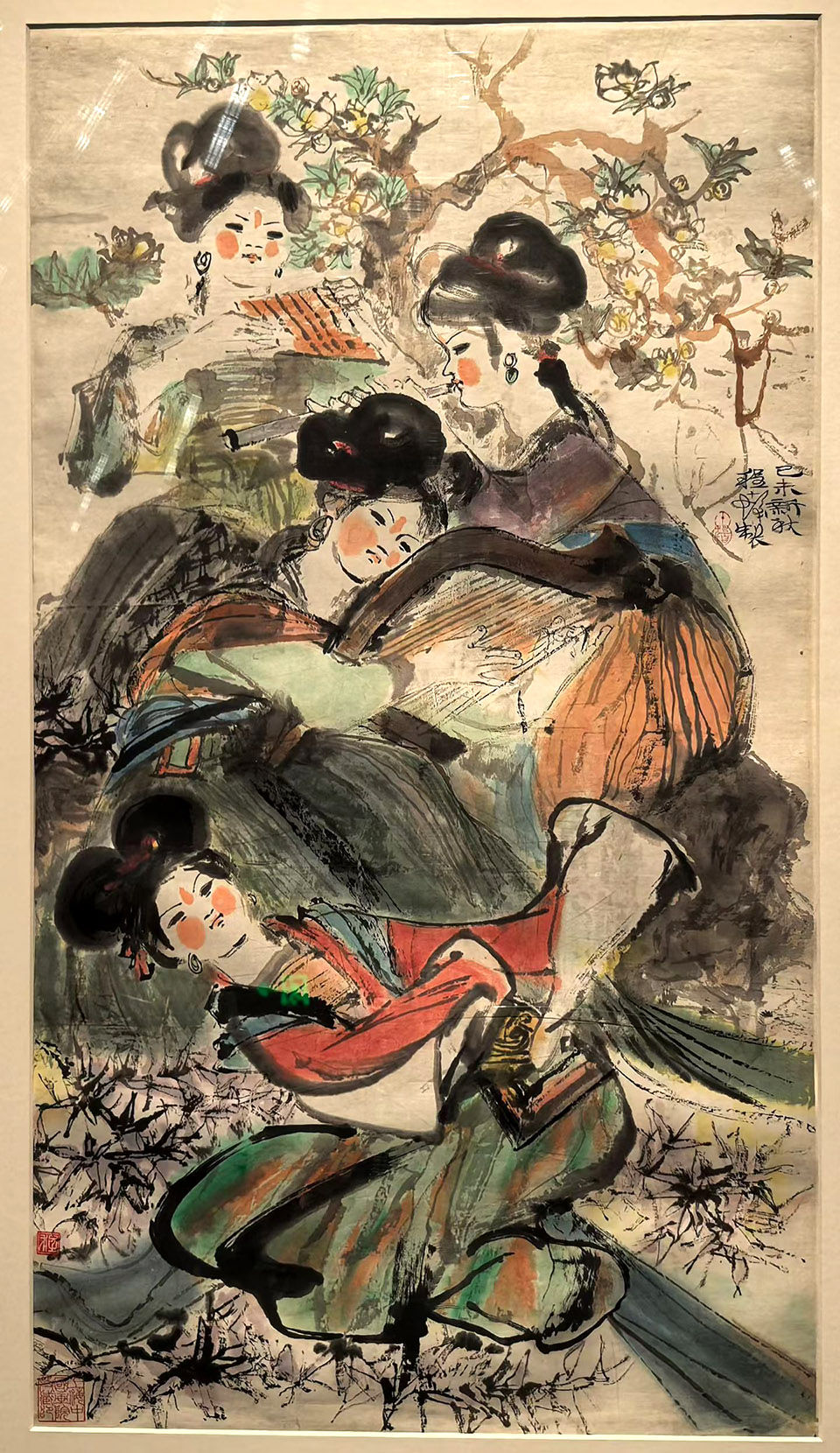
From the perspective of modeling and brushwork, Cheng Shifa’s figure paintings are the most representative, with subjects focusing primarily on young women and elderly literati or scholars. His female figures are rounded and ingenuous, absorbing extensively the exaggerated structures of folk clay sculpture, such as the Wuxi A-Fu figures. In the actual painting process, Cheng Shifa would often first use unrestrained brushwork and color ink to sweep freely across the surface, establishing the overall masses of the depicted forms and their light-and-shadow orientation; then, while the color ink was partially dry, he would use refined lines to accurately delineate the structural features of the figures. His brushwork pursued “killing” force and composure, with dry brush and withered brushwork complementing one another, displaying extraordinary explosiveness and an irreproducible spontaneity of artistic inspiration. The evolution of his brush-and-ink language is clearly discernible: the 1970s were characterized by elegant fluidity, freshness, and enduring charm; the 1980s reached a state of consummate mastery and effortless execution; while in his later years, his style became increasingly expansive, seasoned, austere, and naturally unadorned.
From the perspective of the synthesis of Chinese and Western approaches and cross-disciplinary absorption, Cheng Shifa was a master artist of exceptionally modern vision. He studied the Pre-Raphaelites, Käthe Kollwitz’s woodcuts, Frans Masereel’s graphic novels and picture narratives, and Sergei Eisenstein’s cinematic montage techniques in depth, skillfully incorporating the editing principles and compositional tension of film into his Chinese painting and lianhuanhua creations. In his use of color, in addition to traditional Chinese painting pigments such as mineral azurite blue, mineral malachite green, and rouge, he boldly incorporated the Impressionist principle of complementary light and color, while also understanding the mutual correspondence of colors through photography. In addition, he drew from Kunqu and traditional Chinese opera dance an understanding of the flowing rhythm of lines, imbuing his compositions with a powerful sense of theatrical rhythm.
In the fields of landscape and bird-and-flower painting, Cheng Shifa likewise demonstrated outstanding innovation in brush-and-ink language. His bird-and-flower paintings inherited the epigraphic vigor and monumental spirit of Wu Changshuo’s xieyi style, and his achievements in brush and ink even surpassed those of his figure paintings. His landscape paintings primarily served as backgrounds for figures during the 1950s and 1960s, established an independent style in the 1970s, reached maturity in the 1980s, and became concise, vigorous, and seasoned in his later years. Deeply devoted to the literati painting tradition of the Southern School, he ingeniously used variations in the size, density, and positive-negative spatial relationships of ink masses to replace the chiaroscuro of Western drawing, realizing a modern ideal of landscape painting characterized by the fusion of color and ink.
Cheng Shifa’s calligraphy is regarded as a typical form of “painter’s calligraphy,” with an unconventional structure and compositional organization. Influenced in his early years by Li Jian’s stele and inscription calligraphy, he drew strength from the concise simplicity of Qin and Han wooden slips and the unrestrained vitality of Huaisu’s wild cursive script, fusing cursive, seal, clerical, and regular scripts into a single whole. He described his own style as “lying somewhere between seal, cursive, clerical, and regular script.” He favored variant Chinese characters and freely mixed regular, running, and cursive scripts. His structures were given form according to spontaneous impulse, without insisting on consistency of script style throughout an entire work, thereby forming an original calligraphic style that was free and uninhibited yet imbued with an ancient sensibility, seamlessly integrated with his paintings.

Academic Forms and Exhibition Analysis of Representative Works
Taking “Dedicated to Life — Exhibition of Works by Cheng Shifa from the Collection of the Shanghai Chinese Painting Academy” as the point of observation, Cheng Shifa’s creative output can be divided into five core sections: thematic painting, ethnic minority subjects, beauties and literati/elderly scholar subjects, bird-and-flower painting, and calligraphy. The representative works in each section fully demonstrate his ability to distill the beauty of everyday life into refined art.
Creative Subject Category: Thematic Painting
Representative Work: Singing the Spring of the Motherland
Year of Creation: 1957
Dimensions and Format: 137 × 81 cm, hanging scroll
Academic Value and Aesthetic Characteristics: A landmark representative work that established his reputation and won First Prize at the National Youth Art Exhibition. It integrates the new spirit of the era with classical brush-and-ink techniques, pioneering a new style of realistic thematic painting.
Creative Subject Category: Thematic Painting
Representative Work: People Who Dress Up Life
Year of Creation: 1958
Dimensions and Format: 75.5 × 46 cm, mounted painting
Academic Value and Aesthetic Characteristics: Created after an in-depth visit to Jiuxin Enamel Factory to sketch from life, the work is filled with enthusiasm for the new life and demonstrates the integration of everyday secular existence with artistic creation.
Creative Subject Category: Ethnic Minority Subjects
Representative Work: Ruili River Draped in Light Gauze
Year of Creation: 1957
Dimensions and Format: 141 × 82 cm, hanging scroll
Academic Value and Aesthetic Characteristics: A milestone of the period of transformation following his frontier sketching activities. Its brilliant colors and substantial ink resonance established the fundamental tone of the “Cheng Family Style” in paintings depicting ethnic customs.
Creative Subject Category: Ethnic Minority Subjects
Representative Work: Gathering Medicinal Herbs
Year of Creation: 1981
Dimensions and Format: 82 × 50.5 cm, mounted painting
Academic Value and Aesthetic Characteristics: A representative ethnic minority figure painting from his peak period. Its lines are fluid and rounded, while the brushwork possesses penetrating “killing” force, conveying an artistic conception filled with the vitality of spring in the human world.
Creative Subject Category: Bird-and-Flower Painting
Representative Work: Spring Clears and Again Delights in the Freshness of a Flower
Year of Creation: 1973
Dimensions and Format: 19 × 16 cm, album leaf
Academic Value and Aesthetic Characteristics: Profound artistic conception within a small format. The composition of a flowering branch conveys a far-reaching poetic atmosphere, embodying the textural quality of Wu Changshuo’s xieyi brushwork as well as auspicious symbolism.
Creative Subject Category: Bird-and-Flower Painting
Representative Work: Doves · Flowers and Rocks
Year of Creation: 1983
Dimensions and Format: 136.5 × 66.5 cm, hanging scroll
Academic Value and Aesthetic Characteristics: A major bird-and-flower work from his mature period. Epigraphic brushwork is integrated with light, shadow, and color, while the doves are rendered in an ingenuous and lively manner.
Creative Subject Category: Calligraphy
Representative Work: Running Script · Lu You’s Poem “Early Summer After the Rain Clears”
Year of Creation: 1986
Dimensions and Format: 136.5 × 31.5 cm, hanging scroll
Academic Value and Aesthetic Characteristics: A typical example of his calligraphic style “lying somewhere between seal, cursive, clerical, and regular script.” The brushwork is naïve and ingenuous, while the composition is unconventional yet rich in archaic charm.
Evolution of the Secondary Market and the Value of Art as an Asset Allocation
In the secondary art market, Cheng Shifa’s works, supported by a broad popular base and profound academic recognition, have long played the role of “blue-chip stocks” within the Shanghai School painting and calligraphy segment. Looking across more than two decades of market evolution, his pricing system has demonstrated a high degree of stability and a stepwise upward trend.
In the early 2000s, the market prices of Cheng Shifa’s ordinary bird-and-flower and figure paintings generally remained in the range of tens of thousands to more than one hundred thousand RMB. Beginning in 2005, with the explosive growth of the Chinese painting and calligraphy market, his finest works rapidly entered the million-RMB range. For example, at a China Guardian auction in 2010, Cheng Shifa’s Twelve Panels of Birds and Flowers sold for RMB 1.12 million; in the same year, at Duoyunxuan’s spring auction, his 1981 work Early Spring in Yaoshan achieved a hammer price of RMB 3.58 million. By 2014, the average price per Chinese-foot unit of Cheng Shifa’s works had stabilized at approximately RMB 130,000–150,000, while the price per unit for top-tier masterpieces exceeded RMB 300,000.
In terms of mounting formats, historical auction data indicate that collectors in the secondary market have shown particular preference for Cheng Shifa’s album leaves and handscrolls. These two formats command significantly higher premiums per unit area than conventional hanging scrolls and mounted paintings.
Work: Miscellaneous Paintings Album from the Sanfu Study (Twelve Leaves)
Year of Creation: Mature Period
Auction House: Beijing Changfeng
Transaction Year: 2010
Sale Price (RMB/HKD): RMB 7,610,000
Format and Academic/Market Highlights: An album masterpiece demonstrating comprehensive accomplishment across multiple subjects and setting a high-price record for album leaves.
Work: The Picture of Bu Gun — Handscroll
Year of Creation: 1979
Auction House: Christie’s Hong Kong
Transaction Year: 2014
Sale Price (RMB/HKD): HKD 6,010,000
Format and Academic/Market Highlights: A rare large-scale work executed entirely using the double-outline technique of Song Dynasty painters; its price doubled over nine years compared with RMB 2.86 million in 2005.
Work: Album of Stories from Strange Tales from a Chinese Studio (Six Leaves)
Year of Creation: Mature Period
Auction House: Xiling Auction
Transaction Year: 2011
Sale Price (RMB/HKD): RMB 5,630,000
Format and Academic/Market Highlights: A model of the integration of literary illustration with Chinese painting brush-and-ink techniques, achieving a high premium upon resale.
Work: Album of Birds, Flowers and Fish (Twelve Leaves)
Year of Creation: 1985
Auction House: Beijing Poly
Transaction Year: 2013
Sale Price (RMB/HKD): RMB 3,350,000
Format and Academic/Market Highlights: An album of large-scale xieyi bird-and-flower paintings from his mature later period.
Work: Scroll of Treasures Surviving the Catastrophe of the Cultural Revolution — Handscroll
Year of Creation: Special Historical Period
Auction House: Shanghai Duoyunxuan
Transaction Year: 2011
Sale Price (RMB/HKD): RMB 2,300,000
Format and Academic/Market Highlights: A handscroll treasure possessing special historical and documentary value.
Work: Album of Figure Stories of Wu Zetian (Eight Leaves)
Year of Creation: 1960
Auction House: Shanghai Jiahe
Transaction Year: 2017
Sale Price (RMB/HKD): RMB 1,357,000
Format and Academic/Market Highlights: A representative work within the category of original manuscripts for historical-figure lianhuanhua illustrations.
In addition to conventional bird-and-flower and beauty subjects, two specialized segments—“red revolutionary themes” and “original lianhuanhua illustration manuscripts”—have developed independent upward market trajectories in recent years. Cheng Shifa’s original lianhuanhua manuscripts, such as Zhaoshutun and Nannona, once set the auction record for Chinese lianhuanhua, combining literary dissemination with the artistic qualities of ink painting and attracting strong interest from cross-disciplinary collectors. At the same time, red-themed Chinese paintings depicting the construction of New China during the 1950s–1960s, owing to their strong documentary scarcity and exceptionally high transaction rates, constitute core assets with the potential for counter-cyclical appreciation.

Collector’s Authentication Guide and Risk-Mitigation Mechanisms
The greatest potential risk in investing in Cheng Shifa’s artworks lies in the proliferation of forgeries in the secondary market. According to industry veterans and disclosures by members of Cheng Shifa’s family, the forgery rate of Cheng Shifa’s works is high among small and medium-sized auction houses and informal trading channels; in some cases, entire auctions may contain no genuine works at all. During the process of authentication and acquisition, collectors should guard against the following two common methods of forgery:
The first is the “watermarked woodblock print with added ink” forgery. Established traditional stationery and art institutions such as Duoyunxuan once legally produced large quantities of fine watermarked woodblock reproductions of Cheng Shifa’s works. Some counterfeiters exploit weaknesses in the quality control of small auction houses by manually adding ink, applying forged seals, or supplementing inscriptions on watermarked woodblock prints, passing them off as hand-painted originals and placing them on the market. The key to identifying this type of forgery is to use a high-magnification loupe to examine whether the edges of the lines exhibit the pressure marks or dot-like diffusion characteristic of printmaking, and to compare the degree of natural integration between the ink and the paper.
The second is the “projector tracing” forgery. Counterfeiters use projection equipment to project the outlines of genuine Cheng Shifa works onto xuan paper and then trace and fill in the colors. Because Cheng Shifa painted extremely rapidly, as if “a violent storm sweeping across,” his lines display dramatic variations in thickness and are filled with a supple, extended rhythm and penetrating “killing” force. Projector-traced forgeries often reveal hesitation during the outlining process, resulting in delayed nodes, stiff flying-white effects, and dry or withered brush strokes lacking artistic vitality. These defects can readily expose traces of forgery.
With the formal implementation in 2023 of the National Cultural Heritage Administration’s list of renowned artists whose works are restricted from leaving China, representative works by Cheng Shifa are now subject to strict restrictions on export. This administrative protection mechanism fundamentally locks in high-quality domestic resources. The long-term retention of Cheng Shifa’s finest works by public art museums and top private institutions will further intensify the scarcity of genuine works available in the market, encouraging continued price appreciation for masterpieces with clear publication records and well-documented and distinguished provenance.

Asset Allocation Recommendations
As a culminating master of the transformation of Shanghai School art from tradition to modernity, Cheng Shifa’s artistic value lies not only in his original visual breakthrough represented by the “Cheng Family Style,” but also in his profound practice of the essence of life and his cultural responsibility of serving the nation through art. From the perspective of art-asset allocation, Cheng Shifa’s works demonstrate the dual characteristics of a strong academic moat and stable appreciation potential.
For collectors of Shanghai School art and high-end art enthusiasts, this report proposes three allocation strategies:
First, establish a “format-first” strategy, using album leaves and handscrolls with clear publication records and well-documented provenance as core allocation targets in order to obtain higher capital returns per unit area.
Second, focus on the “golden creative periods,” with particular attention to ethnic minority figure paintings and bird-and-flower masterpieces from the frontier-sketching transformation period of the 1950s and the mature brush-and-ink period of the 1970s–1980s.
Third, focus on “breakthroughs in distinctive subject matter,” closely tracking high-scarcity segments such as red-themed paintings and original lianhuanhua manuscripts, and, while mitigating the risk of forgery, pursue the long-term preservation and appreciation of Shanghai School art assets.


Comments