


Jade Through Millennia: The Value, Potential, and Risks of Archaic Jade Collecting

Updated: Sep 22, 2025
By OGP Reporters / Members Contribute File Photos

Oh Good Party
Archaic jade embodies both aesthetic brilliance and cultural symbolism, serving as one of the direct root systems of Chinese civilization. From Hongshan to Liangzhu, these artifacts are not only witnesses to early cultural origins but also focal points of today’s collecting market.
I. Exhibition Review
“Dragon Soars in China: The Hongshan Cultural Ancient Civilization Exhibition” opened on June 26, 2025, at the East Wing of the Shanghai Museum. The exhibition, free to the public, will run until October 8. It is the fourth major archaeological exhibition in the Shanghai Museum’s “Why China” series and brings together over 300 precious artifacts from 20 museums and archaeological institutes across Liaoning, Inner Mongolia, Hebei, Beijing, and other regions. More than one-quarter of the exhibits are being shown to the public for the first time.
The exhibition is organized into three thematic sections: “Religious Beliefs,” “Ritual Systems,” and “Social Structures.” Together, these illustrate how the Hongshan culture developed its ritual systems, jade ceremonial traditions, and the social and spiritual structures that bridged the transition into early civilization. The exhibition design adopts “Hongshan Red” as a dominant color theme, with a central axis and monumental structures to create an immersive experience.
Highlights include iconic artifacts such as the C-shaped Jade Dragon and the Ring-shaped Jade Dragon: the former, fully C-shaped with a translucent and lustrous jade body, is a representative masterpiece of Hongshan jade; the latter, as the earliest discovered of its kind, is considered a groundbreaking piece within the jade ritual system.

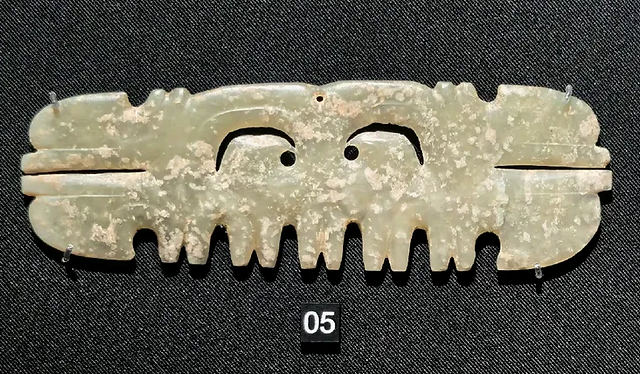


Selected Exemplary Artifacts
Ring-shaped Jade Dragon
Hongshan Culture (c. 6500–5000 years ago)
Unearthed in 1987, Hexi, Aohan Banner, Inner Mongolia
Collection of Aohan Museum (Aohan Banner Cultural Heritage Protection Center)
Geometric-pattern Pottery Jar
Zhaobaogou Culture (c. 7200–6500 years ago)
Unearthed at Zhaobaogou site, Aohan Banner, Inner Mongolia
Collection of Chifeng Museum
Painted Pottery Jar with Double Handles
Hongshan Culture (c. 6500–5000 years ago)
Unearthed in 2021 at Ma’anqiaoshan site, Jianping, Liaoning, Ritual Pit No. 1
Collection of Liaoning Provincial Institute of Archaeology
Jade Turtle Shell
Hongshan Culture (c. 6500–5000 years ago)
Unearthed in 1989 at Site No. 21, House 1, Location 2, Niuheliang, Jianping, Liaoning
Collection of Liaoning Provincial Institute of Archaeology
Jade Eagle
Hongshan Culture (c. 6500–5000 years ago)
Collection of Aohan Museum (Aohan Banner Cultural Heritage Protection Center)
Jade Owl
Hongshan Culture (c. 6500–5000 years ago)
Collection of Chaoyang Museum
Jade Cicada
Hongshan Culture (c. 6500–5000 years ago)
Unearthed in 2003 at Niuheliang site, Tomb No. 1, Location 16, Lingyuan, Liaoning
Collection of Liaoning Provincial Institute of Archaeology
Cloud-shaped Jade Ornament
Hongshan Culture (c. 6500–5000 years ago)
Collection of the Palace Museum
Cloud-shaped Jade Ornament
Hongshan Culture (c. 6500–5000 years ago)
Unearthed at Niuheliang site, Tomb No. 1, Location 2, Jianping, Liaoning
Collection of Liaoning Provincial Museum
Jade Beast Head
Hongshan Culture (c. 6500–5000 years ago)
Collection of Tianjin Museum
Dragon-and-Phoenix Jade Pendant
Hongshan Culture (c. 6500–5000 years ago)
Unearthed in 1991 at Niuheliang site, Tomb No. 23, Location 2, Jianping, Liaoning
Collection of Liaoning Provincial Institute of Archaeology
Jade Ring (Jue)
Xinglongwa Culture (c. 8000–7000 years ago)
Unearthed between 1988–1991 at Baiyinchanghan site, Tomb No. 4, Linxi, Inner Mongolia
Collection of Inner Mongolia Institute of Archaeology
Seated Jade Figurine
Hongshan Culture (c. 6500–5000 years ago)
Collection of the Palace Museum
Pottery Male Figurine
Hongshan Culture (c. 6500–5000 years ago)
Unearthed in 2024 at Dongshantou site, Pingquan, Hebei
Collection of Hebei Provincial Institute of Archaeology
Stone-carved Human Face
Hongshan Culture (c. 6500–5000 years ago)
Unearthed at Qijiacun, Aohan Banner, Inner Mongolia
Collection of Chifeng Museum
Together, these artifacts systematically present the Hongshan culture’s full spectrum—from daily life to religious rituals—while underscoring jade’s central role in its spiritual and social systems.


II. Historical and Cultural Value of Archaic Jade
Since the Neolithic period, jade has held a revered place in Chinese culture. Preceding both bronze and written script, jade was widely used in weaponry, ritual objects, ornaments, and burial items. Compared with jade traditions in Mesoamerica, the South Pacific, or Persia, China’s jade culture is the most enduring and complete, uniquely integrated with ritual systems, religion, and political power.
Although Chinese archaeology began in the early 20th century, prior studies of Neolithic jade relied heavily on speculation. Only in the 1970s did systematic excavations and artifact conservation efforts transform jade studies into a scientific discipline.
Hongshan Culture (c. 4500–3000 BCE)
Centered in the Liao River and Xilamulun River basins, Hongshan jade is characterized by ritual complexes (altars, temples, tombs) and animal motifs. Though simple in form, the craftsmanship is refined. The representative Jade Pig-Dragon features a coiled dragon-like body and a pig-like head—an early dragon prototype later replicated across dynasties. Other recurring motifs include birds, turtles, and cicadas, the latter symbolizing reincarnation and rebirth.
Dawenkou Culture (c. 3550–3050 BCE)
Located in the Dawen River basin of Shandong, Dawenkou jade reflects growing social stratification. Items such as jade axes, rings, and discs became symbols of power. The craftsmanship is modest yet elegant, prioritizing ornamentation over function. Unlike Hongshan, no definitive evidence of ritual-use jade has been found to date.
Liangzhu Culture (c. 3300–2200 BCE)
Spanning the Taihu basin and Jiangsu-Zhejiang-Shanghai region, Liangzhu produced the finest jade of the Neolithic, across more than 1,300 years and two distinct phases. Its jade can be categorized into three groups: (1) ritual objects (cong, axes, blades, gui, discs); (2) adornments (plaques, pendants, rings); and (3) beads and miniature pieces, sometimes inlaid with jade fragments. The cong and bi reached aesthetic and symbolic peaks, adorned with intricate geometric and bird motifs, embodying cosmology. The jade cong, with its square exterior and round interior, symbolizes the order of heaven and earth and is hailed as tangible proof of 5,000 years of Chinese civilization.
Longshan Culture (c. 2500–2000 BCE)
Found in Shandong’s hilly regions, Longshan inherited many Dawenkou traditions but expanded jade’s functional and ritual repertoire. Jade spades, axes, and chisels proliferated, while ritual jades such as xuanji (rotating discs) and zhang (ceremonial tablets) first appeared, marking the emergence of state-level authority.
Collectively, these archaeological findings chart jade’s evolution from spiritual symbol (Hongshan) to ritual system (Liangzhu), and finally to instruments of state power (Longshan). Jade transcended mere decoration to become a witness of civilization’s origins.


III. Collecting and Investment Analysis
A. Market Trends and Data
In recent years, archaic jade has become a major focus in the collecting market. In 2024, Christie’s Hong Kong Autumn Sale “Essence of Taiyi: The Lantian Shanfang Archaic Jade Collection” created a sensation. The auction offered 75 pieces spanning from the Neolithic to the Eastern Han, all with impeccable provenance, having been exhibited in the 1999 National Palace Museum Taipei show “Further Selections from the Hidden Collection of Jades.” The sale achieved a total of HKD 214,778,200, with two white-glove sessions.
Highlights included:
One of only twelve known Liangzhu bird-altar-pattern jade discs;
The largest and most vividly carved known Western Han turquoise bixie sculpture;
Western Han white jade ear cup and spoon, reflecting jade’s expansion beyond ritual into daily life.
These results confirmed that jade with academic value, clear provenance, and rare typology enjoys intense demand in the global market. Significant price premiums demonstrate both collectors’ passion and the market’s strong tolerance for top-tier archaic jade.


B. Investment Advantages and Risks
Advantages:
Rarity – Limited excavated quantity of Hongshan and Liangzhu jade with distinctive forms.
Cultural & Academic Value – Key witnesses to the origins of Chinese civilization, ritual systems, and dragon worship.
Appreciation Potential – Significant premiums at auctions signal robust long-term demand.
Risks:
Forgeries – High prevalence of fakes; authenticity requires expert and scientific verification.
High Entry Barrier – Top-tier pieces often exceed millions in HKD, deterring new entrants.
Low Liquidity – Sales rely on major auctions; secondary market options are limited.
Preservation Costs – Susceptible to cracks; requires controlled environments and specialized handling.


C. Practical Collecting Guidelines
Begin with Exhibitions
Study canonical forms and craftsmanship firsthand through exhibitions and pre-auction viewings.
Prioritize Provenance
Focus on jade with museum exhibition, publication, or reputable collection history.
Track Auctions and Scholarship
Monitor upcoming Christie’s, Sotheby’s, and other specialized jade sales; compile transaction data.
Build Multi-layer Authentication
Employ laboratory analysis (material, wear, polish) alongside provenance documentation.
Phased Investment Strategy
Entry: Acquire accessible, smaller pieces with clear forms.
Growth: Expand to core long-term holdings once value stability is confirmed.
Balance Investment with Scholarship
Integrate cultural and academic engagement. Loaning works for exhibitions or publications enhances both recognition and long-term value.


Archaic jade embodies both aesthetic brilliance and cultural symbolism, serving as one of the direct root systems of Chinese civilization. From Hongshan to Liangzhu, these artifacts are not only witnesses to early cultural origins but also focal points of today’s collecting market.
While enthusiasm is high, risks such as forgery and illiquidity remain pressing. The most prudent path for collectors is to approach jade through exhibitions and academic research, build thematic and research-driven collections step by step, and prioritize authenticity, provenance, and scholarship over financial return. Only by doing so can one establish a secure foothold in the field of archaic jade collecting.


Comments