


Recasting Antiquity: The Collecting Value of Chinese Bronzes Through the Song-Yuan-Ming-Qing Exhibition - A Guide to Collecting Chinese Bronzes

Updated: Mar 28
By OGP Reporters / Members Contribute File Photos

Oh Good Party
Chinese bronzes represent one of the most important artistic legacies of Chinese civilization. From the ritual vessels of the Xia, Shang, and Zhou dynasties to the archaistic bronzes of the Song, Yuan, Ming, and Qing periods, these works not only record the institutional structures of ancient Chinese society but also reflect the evolution and continuity of artistic aesthetics. Bronzes once symbolized ritual authority, political power, and religious belief. Over several millennia, they witnessed the development of Chinese ritual civilization and have become essential material evidence for the study of ancient politics, religion, and social organization. However, the field of bronze collecting presents a high threshold for entry. The market is complex, and forgeries are widespread. Collectors entering this field must therefore exercise great caution and should, whenever possible, seek guidance from professional scholars and institutions.
Note: This guide is relatively extensive and slightly academic in tone. It was developed with the participation of OGP specialists and experienced collectors, combining research with practical collecting experience. Ancient Chinese bronzes occupy a uniquely important position in the Chinese art market, shaped not only by their high value but also by historical and regulatory constraints. If you are interested in collecting bronze objects, we recommend reading the guide patiently. Its purpose is to provide a comprehensive overview and help collectors avoid common pitfalls in the market.
Chapter 1 - The Value of Later Bronzes Seen Through the Exhibition “Recasting Antiquity
In the history of Chinese art, bronze vessels are often regarded as symbols of the Shang and Zhou civilizations. In recent years, however, both scholars and collectors have begun to reexamine the artistic significance of archaistic bronzes produced during the Song, Yuan, Ming, and Qing dynasties.
The exhibition Recasting Antiquity: The Art of Chinese Bronzes, 1100–1900, jointly organized by the Shanghai Museum and the Metropolitan Museum of Art in New York, represents an important academic and artistic event.
The exhibition brings together more than two hundred works from museums in China, the United States, and Europe. Through four thematic sections, it systematically presents the development of bronze art during the Song, Yuan, Ming, and Qing periods.
From archaistic ritual vessels to scholar’s studio objects, from imperial ceremonial implements to refined objects of daily appreciation, these works reveal a distinctive cultural phenomenon: taking antiquity as inspiration while pursuing artistic innovation.
One notable example in the exhibition is the Dasheng Bell, produced during the reign of Emperor Huizong of the Northern Song dynasty. As part of Huizong’s reform of court ritual music, a large system of ceremonial bells was cast in order to revive ancient ritual traditions. The Dasheng Bell thus became an important symbol of state ritual and remains a key artifact for studying Song-dynasty metallurgy and musical institutions.
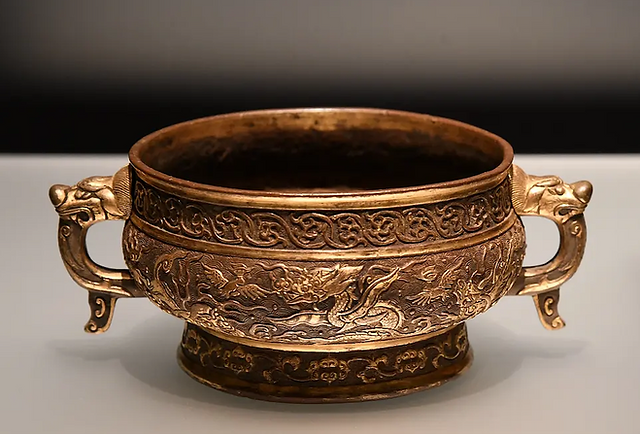
Another representative piece is the Bronze Gui Vessel of the Kunshan County School, dated to the twentieth year of the Chenghua reign of the Ming dynasty. The inscription records that it was “made according to illustrated models in the temple school of Kunshan County.” The vessel was modeled after Zhou-dynasty bronzes illustrated in the Song-dynasty catalogue Xuanhe Bogutu, yet Ming artisans introduced innovations such as adding a lid and adjusting the proportions. The work reflects the artistic principle of reviving antiquity without rigid imitation.
The exhibition also includes gilt bronzes, imperial bronze vases, and Buddhist sculptures, demonstrating the high level of craftsmanship achieved in Ming and Qing bronze production. In particular, the Xuande-period incense burners and imperial Buddhist sculptures are widely considered among the highest achievements in the history of Chinese bronze art.
Through these works, it becomes clear that Song–Yuan–Ming–Qing bronzes were not merely imitations of ancient ritual vessels. Rather, they represent a fusion of cultural revival and artistic innovation, which is precisely why later bronzes have gradually attracted greater attention in the field of collecting.


Chapter 2 - Historical Background and Collecting Context of Chinese Bronzes
Here we focus primarily on the collecting of Chinese bronzes.
Bronze refers to an alloy produced by smelting copper with elements such as tin or lead in specific proportions. Because copper alloys often develop a greenish or bluish patina after oxidation, the material is known as “bronze.”
The history of Chinese bronzes can be traced back more than three thousand years, to the Shang and Zhou periods. At that time, bronze smelting and casting technologies represented one of the most advanced technical capabilities of a tribe or state.
In the Bronze Age, the control of metallurgical technology and mineral resources was directly linked to military power, religious authority, and political rule. Bronze objects were not merely utilitarian tools; they were also powerful symbols of political authority and ritual legitimacy.
Ancient people held deep reverence for heaven and the natural world. Early societies believed that ancestral spirits could influence the living world, leading to the formation of a religious system centered on ancestor worship and sacrificial rituals.
Royal authority was reinforced through the ruler’s role as mediator between the human and spiritual worlds. By conducting ritual ceremonies and communicating with ancestral spirits, rulers demonstrated the legitimacy of their rule. Bronze ritual vessels therefore functioned not only as objects but also as symbols of state authority and religious belief.
From the perspective of social function, bronze objects can generally be divided into four categories:
Ritual Vessels
During the Shang and Zhou periods, the aristocracy revered spirits, emphasized ritual sacrifice, and practiced forms of shamanistic worship. Through a complete set of bronze vessels, the ruling class established what became known as the ritual and music system, which symbolized royal authority, social hierarchy, and political order.
Bronze ritual sets typically included food vessels, wine vessels, water vessels, musical instruments, and sometimes weapons, arranged according to strict hierarchical rules. These objects carried strong religious and political meanings.
Heavy Ritual Objects (Zhongqi)
Large single-cast bronzes with significant inscriptions are often referred to as “important ritual objects.” These vessels were used to commemorate major historical events or to praise the achievements of ancestors and rulers.
Bronzes with long inscriptions and rich historical content are especially valued for their historical importance.
Mingqi (Funerary Objects)
“Mingqi” literally means “vessels for the spirits.” Ancient people believed that the soul continued to exist after death and would live in another world. As a result, aristocratic burials during the Shang and Zhou periods often included bronze vessels, jade objects, ceramics, and other items used during the deceased’s lifetime.
Objects such as ding, gui, dou, hu, and he vessels were buried with the deceased so they could continue to serve them in the afterlife.
The number and types of bronzes buried in tombs were strictly regulated according to social rank. For example, in the Western Zhou ritual system, the number of bronze ding vessels permitted in a tomb varied according to whether the deceased was a king, a feudal lord, or a high official.
These burial objects were still part of the ritual vessel system and were not simplified objects specially produced for funerary use in the later sense.

Main Types of Shang and Zhou Bronzes
Bronze objects of the Shang and Zhou periods can be broadly divided into three main categories:
Ritual vessels
Ding, gui, zun, jue and similar vessels used in ancestor worship
Weapons
Ge (dagger-axes), spears, swords
Musical instruments
Bells such as zhong and bo
The earliest copper artifacts discovered in China were found at the Jiangzhai site of the early Yangshao culture in Shaanxi, dating approximately 6500–6700 years ago. However, a fully developed bronze civilization began during the Erlitou culture (c. 1900–1500 BCE).
Excavations at Erlitou have revealed bronze ritual vessels, tools, and casting workshops, marking the beginning of China’s bronze civilization.
Bronze objects were also valuable because of the strategic nature of their material. In ancient times, copper could be used not only for ritual vessels but also for weapons and currency. For this reason, it was considered a strategically controlled resource.
Copper mines, metallurgical technologies, and casting techniques were often directly controlled by the state or royal authority.
As a result, authentic ancient bronzes were never ordinary household objects. They were typically owned only by royal courts, aristocratic elites, or major clan lineages.


Historical Stages in the Development of Chinese Bronzes
After the middle Shang period, the number of bronze vessel types increased rapidly, and inscriptions gradually began to appear.
The late Shang and early Western Zhou periods represent the golden age of Chinese bronze production. Vessels from this time are monumental in form and richly decorated with complex patterns such as taotie masks and kui dragons.
During the middle Western Zhou, decoration became gradually simpler, and vessel shapes became more rationalized.
During the Spring and Autumn and Warring States periods, the spread of iron technology reduced the role of bronze in military and agricultural production. However, bronze continued to develop in ceremonial and decorative contexts.
In the Qin and Han periods, bronze containers became less common, but bronze continued to be widely used for mirrors, coins, and weapons.
An important chapter in the history of Chinese bronze civilization is the Sanxingdui site, where large numbers of bronze objects have been discovered. Many of these were produced using sectional casting techniques and internal core structures, and some were decorated with black and red pigments. This indicates that painted bronze decoration in China can be traced back to the late Shang period.
In the Central Plains, bronze casting technology developed into a mature copper-tin-lead ternary alloy system, using the distinctive piece-mold casting method. Representative examples include the Duling Square Ding excavated in Zhengzhou and the famous Houmuwu Ding from Yinxu.
The Changing Social Role of Bronzes
After the Song, Yuan, Ming, and Qing periods, the social function of bronze objects changed significantly.
Bronzes gradually transformed from ritual vessels of the Xia–Shang–Zhou periods into imperial collectibles, and later into objects appreciated by scholar-officials and literati in the Ming and Qing dynasties.
The rise of epigraphy (jinshixue) during the Song dynasty encouraged scholars to systematically study and collect ancient bronzes. Publications such as the Xuanhe Bogutu catalogued and illustrated ancient bronzes and exerted tremendous influence at the time. These works directly stimulated the production and collection of archaistic bronzes.
By the Ming and Qing periods, bronze objects increasingly entered the scholar’s studio and became an important part of literati interior decoration.
Examples include: incense burners, vases, water droppers, scholar’s desk ornaments
These objects often imitated the forms of Shang and Zhou ritual vessels but were used primarily for daily enjoyment and aesthetic display.


The Value of Chinese Bronzes in the Modern Art Market
Chinese bronzes are renowned worldwide for their exceptional craftsmanship and represent the highest achievements of ancient Chinese metalworking. As a result, genuine ancient bronzes occupy a very high position in the global art market.
Over the past decade, Chinese law has strictly protected excavated cultural relics. As a result, the number of authentic bronzes available in the market is extremely limited, while the number of reproductions and forgeries is relatively high. Consequently, most important transactions take place in major international auction houses.
For example:
Late Shang Dynasty Bronze Square Zun
Christie’s New York, 2017
Price realized: USD 37,207,500
Formerly in the Fujita Museum collection in Japan, this vessel is one of the highest-priced Chinese bronzes ever sold at auction.
Late Shang Dynasty Bronze Square Lei (Fanglei)
Christie’s New York, 2017
Price realized: USD 33,847,500
Standing approximately 63 cm tall, it is among the largest known ritual bronzes and is regarded as one of the greatest masterpieces of Chinese bronze art.
Shang Dynasty Bronze Ram-Shaped Gong
Christie’s 2017
Price realized: approximately USD 27 million
Animal-shaped bronzes are extremely rare within the Shang ritual vessel system and therefore command exceptional market value.
Western Zhou Bronze Pan (Xi Jia Pan)
China Guardian Auctions, 2017
Price realized: approximately RMB 185 million
The vessel bears an inscription of 133 characters, making it one of the longest known bronze inscriptions and an important historical document.
Shang Dynasty Bronze Square Ding
Christie’s New York, 2017
Price realized: approximately USD 2.8 million
Although lower in price than the greatest ritual masterpieces, it still demonstrates the strong value of bronze ritual vessels in the international market.
Shang Dynasty Bronze Square Lei
Sotheby’s Hong Kong, 2025
Price realized: HKD 38.8 million
In contrast, the prices of archaistic bronzes from the Ming and Qing periods vary greatly. For example, a Ming dynasty bronze incense burner sold at Sotheby’s New York in 2025 for only USD 6,096.
This dramatic price difference illustrates the clear hierarchy within the bronze collecting market:
Shang–Zhou bronzes
Top-tier archaeological and museum-level collectibles
Han–Tang bronzes
Important historical artifacts
Song–Yuan–Ming–Qing archaistic bronzes
Art objects valued for craftsmanship and cultural significance
Modern bronzes
Decorative craft objects
Therefore, in the field of bronze collecting, age, historical context, and documentary value largely determine an object’s collecting level and market value.

Chapter 3 - Major Categories in the Collection of Chinese Bronzes
From an archaeological perspective, the Anatolian region of modern-day Turkey is often considered one of the earliest areas in the world to master metal smelting technology. The emergence of bronze metallurgy in China occurred slightly later. However, in terms of the scale of bronze production, the sophistication of casting technology, the artistic refinement of form, and the diversity of object types, no other region in the world developed a bronze tradition comparable to that of ancient China.
Chinese bronze civilization established not only a highly structured ritual system, but also a remarkably advanced technical and aesthetic language. In China, bronzes were never merely functional objects. They served simultaneously as symbols of political authority, religious belief, social hierarchy, and cultural continuity.
This unique combination of technological achievement and symbolic meaning explains why Chinese ancient bronzes occupy a distinct and highly respected position in the global history of art, attracting sustained attention from both the international scholarly community and the world of collectors.
From the perspective of collecting, Chinese bronzes can generally be divided into three major categories.


I. Ancient Masterpieces: Shang and Zhou Dynasty Bronzes
During the Shang and Zhou dynasties, Chinese bronzes developed into a highly sophisticated and systematic artistic tradition. The corpus includes a wide range of categories such as ritual vessels, musical instruments, weapons, and chariot fittings.
These objects were not merely utilitarian. Most were deeply embedded within the ritual and religious structures of early Chinese society.
Decorative motifs commonly include the famous taotie mask, kui dragons, and composite images combining human and animal features. These designs were not simply ornamental. They embodied early Chinese cosmology and religious belief.
In Shang and Zhou society, people believed that ancestors and divine forces could influence the human world, and ritual bronzes served as the primary medium through which communication with these forces occurred. The decorative imagery can therefore be understood as a visual language between the human and spiritual realms, representing one of the earliest symbolic systems of Chinese civilization.
Within the hierarchy of Chinese art collecting, Shang and Zhou bronzes occupy the highest level of significance.
Typical vessel types include:
Ding (tripod cauldrons)
Large ritual ding
Square ding
Li cooking vessels
Yan steamers
Pou jars
Gui food containers
Jue wine vessels
Guan-spouted jue
Gu beakers
Jia tripod wine vessels
Lei wine containers
Handle-arched hu vessels
Gourd-shaped hu
Zhong-post basins
Pan water basins
These objects belong to several functional categories including cooking vessels, wine vessels, and water vessels.
While early forms were relatively simple, by the Shang dynasty a complete ritual wine service—centered around jue, gu, and jia vessels—had already become widespread.
Most surviving examples today originate from archaeological excavations or early documented collections, giving them exceptional historical and scholarly value. They also represent one of the most important categories of Chinese art in the international auction market.
Typical characteristics of Shang and Zhou bronzes include:
exceptionally refined casting techniques
rich epigraphic content
traceable provenance or early collecting history
extreme rarity
Early Shang Bronzes
(c. 16th century – mid-15th century BCE)
During the early Shang period, the foundational system of animal mask decoration was already established.
The primary decorative language consisted of powerful curvilinear patterns formed by bold spiraling lines, creating dynamic and monumental compositions.
Motifs were largely abstract transformations of animals. Apart from the prominent stylized eyes, most lines do not explicitly represent anatomical features, resulting in a highly abstract artistic style.
Decoration was primarily executed in low relief, although some vessels began to display early experiments with high relief elements. For example, zun and lei vessels excavated from the upper Erligan cultural layer show early animal-head sculptural ornaments on the shoulder.
In this period, animal masks typically did not use the thunder pattern (leiwen) as a background, a key diagnostic feature of early Shang bronzes.
Geometric patterns were relatively simple, including:
coarse thunder patterns
linked bead patterns
nipple-boss motifs
Middle Shang Bronzes
(mid-15th century – 13th century BCE)
During the middle Shang period, bronzes underwent significant development in both form and decoration.
Many earlier vessel types such as jue, gu, and jia continued to be produced.
The tail of the jue remained similar to earlier examples, but the pouring spout widened noticeably, and round-bodied jue vessels appeared for the first time.
Jia vessels began to display T-shaped legs in addition to earlier hollow conical legs. Vessel bases increasingly bulged outward, while flat bases became less common.
Large-shouldered zun vessels developed further during this period. Famous examples such as the Funan Tiger-Dragon Zun demonstrate a monumental scale not seen in earlier phases.
The pou jar form also developed during this period. A classic example is the animal-mask pou excavated in Gaocheng.
Tall lei vessels evolved into lower and broader forms with pronounced shoulders. A massive lei preserved in the Palace Museum illustrates this transformation.
Cross-shaped perforations in ring-foot vessels became smaller than in earlier examples.
Ding and li vessels underwent important structural changes. Instead of opposing one leg with an ear, the vessel now adopted the symmetrical arrangement of three legs and two handles, which later became the standard configuration.
Because casting technology had not yet fully solved the problem of core suspension, hollow tripod legs often remained connected to the vessel body.
Most bronzes from this period do not yet bear inscriptions, although some objects display early clan emblems, likely representing ownership marks rather than formal dedicatory texts.
Late Shang Bronzes
(13th – 11th century BCE)
The late Shang period represents one of the highest artistic achievements of Chinese bronze civilization.
In the early phase of the late Shang, several new vessel types emerged:
square yi ritual vessels
zhi wine cups
gong pouring vessels
Square vessel forms developed rapidly during this period, and many wine vessels began adopting angular geometries. Decorative style also changed significantly.
Animal imagery became more clearly defined and partially naturalistic. The distinction between primary decorative motifs and background patterns became pronounced. Background fields were typically filled with dense thunder patterns, creating strong visual contrast with the sculptural relief decoration.
Main motifs were often executed in high relief, and the overall style can be broadly divided into:
rounded sculptural style
sharp, angular style
Inscriptions remained short, usually one or two characters, often representing the owner's clan symbol.
Important changes in vessel forms include:
new variations of ding vessels, including partitioned ding forms
square ding vessels with rectangular bodies and sturdy columnar legs
gui vessels that remained earless but developed shallower bodies with higher maximum diameter
gu beakers becoming increasingly tall and slender with expanding trumpet mouths
flat-bodied jue gradually disappearing while round-bodied examples became dominant
jia vessels gaining animal-head ornaments on the upper plates with taller legs
In weaponry, ge dagger-axes began to develop the characteristic hooked blade and perforated shaft structure.
Late Shang (Final Phase)
Important new forms during the final stage of the Shang dynasty include:
shoulderless zun vessels
flattened you containers
horse-bit fittings and chariot components
Decorative complexity reached an extraordinary level. Animal masks and mythological creatures became extremely intricate, sometimes covering the entire vessel, including the base. The overall aesthetic is solemn, powerful, and ritualistic, reflecting the authority of the Shang religious and political system.
Longer inscriptions also appear during this period, although they usually remain under thirty to forty characters. These texts often record:
clan identities
ancestral rituals
royal rewards
military campaigns
Vessel form developments include:
ding vessels with hoof-shaped legs
increased production of round ding with outward-flaring handles
the widespread appearance of double-handled gui vessels
continued elongation of gu beakers
the disappearance of flat-bottomed jue
broader and lower jia vessels with bag-shaped legs
Weapons such as the ge dagger-axe typically include a hook and one or two perforations.
Bronzes from the Shang and Zhou dynasties frequently achieve prices ranging from several million to tens of millions of US dollars in the international art market.
Bronzes attributed to the Xia dynasty are comparatively rare and often small in scale. Only a few large examples survive, giving them exceptional scholarly importance.

II. Archaistic Ritual Bronzes of the Song, Yuan, Ming, and Qing Dynasties
Bronzes produced during the Song, Yuan, Ming, and Qing periods often imitate earlier Shang and Zhou ritual forms, including:
ding
gui
bian
dou
bronze bells
These objects were typically used in temple rituals, Confucian ceremonial practices, or imperial architectural settings.
Following the rise of epigraphic scholarship (jinshi studies) in the Song dynasty, scholars began systematically studying ancient bronzes and attempted to revive ritual forms through archaistic casting.
The Northern Song court organized large-scale bronze casting programs and compiled important catalogues such as:
Xuanhe Bogutu
Shaoxing Ritual Vessel Illustrations
During the Ming and Qing dynasties, archaistic bronzes became even more widespread, appearing not only in the imperial court but also in local Confucian temples throughout the country.
Although these objects date to later periods, they retain considerable historical and scholarly value—especially those with clear inscriptions or documented temple provenance, such as:
ritual gui vessels from county academies
bronze jue used in Confucian temples
ceremonial bronze bells
These objects are important for understanding the continued transmission of Chinese ritual culture across later dynasties.


Song


Yuan

Ming


Qing
III. Scholar’s Objects and Functional Bronzes
A third category consists of everyday bronze objects widely produced during the Ming and Qing dynasties, including:
incense burners
vases
water droppers
brush stands
mirror stands
paperweights
These objects were typically used in scholars’ studios or religious settings.
With the rise of the literati class during the Ming and Qing periods, the scholar’s studio became an important artistic and cultural space. Bronze, valued for its durability and elegant appearance, gradually became a favored material for studio furnishings.
Some examples—such as Xuande-mark incense burners or gilt bronze Buddhist sculptures—demonstrate exceptional craftsmanship.
However, in most cases the artistic craftsmanship of these objects outweighs their historical significance.
In the modern art market, prices for these bronzes typically range from several thousand to several tens of thousands of US dollars, with only a small number of imperial masterpieces reaching significantly higher values.
By contrast, genuine Shang and Zhou ritual bronzes, because of their historical importance and rarity, frequently reach seven- or eight-figure prices.
For this reason, within the hierarchy of bronze collecting, a clear distinction exists between decorative scholar’s bronzes and the ritual bronzes of early China, the latter remaining the true focus of scholarly and high-level collecting interest.


Chapter 4 - Key Points in the Appreciation of Chinese Bronzes
When collecting Chinese bronzes, several key aspects deserve particular attention.
1 Inscriptions
Inscriptions are among the most important sources for the study of Chinese bronzes and constitute a fundamental basis for both scholarly research and connoisseurship.
Bronze inscriptions are usually cast or engraved on the interior walls or the base of a vessel, and they may record information such as:
the maker of the object
the individual or ancestor to whom a ritual was dedicated
military achievements
clan or family history
Many historical events from early China survive only through bronze inscriptions. For this reason, inscriptions possess not only artistic value but also immense importance as historical documents.
The Chinese Bronze Age spans the Xia, Shang, and Western Zhou dynasties, as well as the Spring and Autumn period and the early Warring States period, lasting more than 1,600 years.
Bronzes from this period can generally be divided into three categories:
ritual and musical vessels
weapons
miscellaneous objects
Even musical instruments were largely associated with ancestral temple rituals, forming an integral component of the classical Chinese system of ritual and music (li-yue).
A well-known example is an Eastern Zhou bronze owl-headed handled ewer once belonging to the Japanese physician Morishō Ichirō, who remained unmarried throughout his life. The vessel later passed to his successor Lü Mozhai (Zhiqiang), and the legendary Japanese antiquities dealer Sakamoto Gorō once facilitated its transaction.
This bronze is an example of a privately collected object with clear and legitimate provenance.
Chinese bronzes have long been one of the most respected categories among experienced collectors. However, because they are extremely important historical artifacts, the Chinese government has implemented strict policies and regulations to protect them, and their circulation is tightly controlled.
Today, bronzes that legally circulate on the market generally fall into two categories:
First: bronzes excavated before 1949 that have well-documented collecting histories and published references confirming their provenance.
Second: bronzes that have returned from overseas collections.
For this reason, the domestic Chinese market for ancient bronzes has historically been relatively quiet. Many transactions take place privately among collectors, and Chinese collectors only began participating in the international auction market on a large scale within roughly the past decade or so.
By the late Warring States period and the Qin and Han dynasties, the traditional ritual system had largely begun to decline. Iron became widely used, and the role of bronze in daily life gradually diminished.
By the end of the Eastern Han dynasty, ceramic technology advanced rapidly, and many everyday bronze objects were replaced by ceramics.
In terms of weapons and tools, iron had already become the dominant material.
During the Sui and Tang dynasties, bronze craftsmanship developed primarily in the form of bronze mirrors, which often featured inscriptions and decorative patterns. After this period, aside from mirrors, traditional bronze vessel production no longer experienced major developments.
s, several key aspects deserve particular attention.


2 Reign Marks and Signatures
Bronze objects from the Ming and Qing dynasties often bear reign marks or workshop signatures.
These marks indicate the date of manufacture, imperial reign title, or the name of a craftsman.
Common examples include:
Xuande marks
inscriptions reading “Made in the Great Ming during the reign of…”
artisan signatures
For example, incense burners from the Xuande reign of the Ming dynasty often bear the mark “Made during the Xuande reign of the Great Ming.”
Such marks are important clues for determining the origin of an object. However, great caution is required in authentication, since later copies frequently imitate these inscriptions.
Therefore, reign marks should never be used as the sole criterion for authentication, but rather as one of several supporting indicators.
3 Materials and Casting Techniques
Recent archaeological discoveries have revealed that in the late Shang and early to middle Western Zhou periods, some bronze objects containing iron were actually cast using meteoritic iron.
The use of meteoritic iron in combination with bronze likely continued from the late Shang through the late Western Zhou. By the late Western Zhou period, techniques for smelting iron and casting it together with bronze had already become relatively mature.
Ancient Chinese bronzes were typically made from a ternary alloy of copper, tin, and lead.
The proportions of these metals varied across different dynasties, resulting in noticeable differences in surface texture, color, and sound. For example, Shang and Zhou bronzes often possess a deep, heavy patina, while Ming and Qing bronzes tend to appear smoother and more refined.
In terms of casting technology, Western Zhou bronzes were primarily produced using the piece-mold casting technique (taofan method). However, the earlier stone-mold casting method, already used during the Xia and Shang periods, continued to exist.
Stone molds were usually employed for casting smaller or simpler objects, such as tools or weapons. Because this method imposed limitations on complex decoration and large-scale forms, it did not develop further during the Western Zhou.
Consequently, the majority of Western Zhou bronzes were still produced using ceramic piece molds, with only a small number cast using stone molds.
When authenticating bronzes made with stone molds, slightly different criteria may apply compared with those cast using ceramic molds. For example, stone-mold bronzes may sometimes exhibit very similar shapes and decorative patterns.
Nevertheless, when assessing features such as sound, corrosion patterns, and weight, the methods used to authenticate Western Zhou bronzes share many similarities with those applied to Xia and Shang bronzes.


4 Vessel Form
From the perspective of form, the manufacturing methods of Western Zhou bronzes were essentially the same as those used during the Xia and Shang dynasties.
The piece-mold casting technique remained dominant, and vessels were typically produced individually, with molds prepared specifically for each object and the entire process carried out by hand.
For this reason, it is theoretically very unlikely for two ancient bronzes to be exactly identical in form.
If two bronzes appearing on the market are completely identical in shape, it is highly probable that at least one is a modern reproduction, and in some cases both may be copies.
Before the Song dynasty, reproductions of ancient bronzes were extremely rare.
During the Song dynasty, however, the rise of epigraphic studies (jinshi scholarship) led scholars to systematically collect and study ancient bronzes. They also began to recognize inaccuracies in earlier ritual diagrams such as the Illustrations of the Three Rites.
As a result, Song scholars began reproducing ritual vessels based on actual excavated bronzes, using them in temple ceremonies.
Evidence of Song-dynasty bronze reproductions appears in several historical texts, including:
Zhonghui Collection by Zhai Ruwen
historical records from the fourth year of Chongning (1105), when the court of Emperor Huizong reproduced the Dasheng bells based on Spring and Autumn-period Song state bells. (Some of these objects still survive today.)
The Qing scholar Sun Yirang, in his Study of Ritual Bronzes of the Zhenghe Era, also recorded many Song-dynasty archaistic bronzes.
During the Yuan dynasty, the government even established a bureau known as the “Wax Casting Office” to produce ritual bronzes modeled after ancient prototypes.
The famous Xuande incense burners of the Ming dynasty also drew inspiration from ancient bronze forms, often adapting them through artistic reinterpretation.


5 Decorative Patterns
Decoration represents one of the most important aesthetic features of Chinese bronzes.
Because bronzes were produced using piece molds, with each object cast individually, it is extremely rare to find two vessels with identical decorative patterns or casting marks.
Only a small number of objects cast with single molds may display identical decoration, but such cases are uncommon during the Western Zhou period.
Western Zhou decoration developed from Shang-dynasty traditions.
During the early Western Zhou, decoration remained at a high level similar to the late Shang period. Many Shang motifs continued to appear, including variations of animal-mask patterns distinguished by different horn forms, such as:
ring-column horn masks
ox-horn masks
outward-curving horn masks
ram-horn masks
inward-curving horn masks
zigzag horn masks
double-dragon horn masks
giraffe-horn masks
tiger-head masks
bear-head masks
By the middle and late Western Zhou period, a distinct decorative vocabulary emerged, including:
ring-band patterns
qu-curve motifs
double-ring patterns
pendant-scale patterns
wave-curve motifs
phoenix-bird motifs
tile patterns
At the same time, a large number of plain bronzes also appeared.
In some Western Zhou vessels, thunder patterns (leiwen) serve as background decoration. This tradition continued the symbolic system of ritual bronzes, as ancient Chinese believed that cloud-thunder patterns represented the heavens.
Mythical creatures depicted above these patterns were therefore understood as beings capable of communicating between heaven and earth. However, thunder patterns were used less frequently during the Western Zhou than during the Shang period, reflecting a broader shift from divine authority toward human social order.
Western Zhou bronzes often display complex decorative compositions combining multiple motifs. A typical arrangement might include:
upper section: qu-curve pattern
middle section: triangular motifs with qu-curves
main body: phoenix or dragon patterns
foot ring: qu-curve decoration
Although complex, these designs maintain strong symmetry and structural balance.
Decoration was organized through contrasts of density and openness, vertical and horizontal structures, and solid versus empty space, creating richly layered yet disciplined compositions.
Another distinctive feature of Western Zhou bronzes is the hierarchical relationship between primary and secondary motifs. While multiple patterns may appear on a vessel, usually only one serves as the dominant decorative theme.
Today, many reproductions of Western Zhou bronzes exist on the market, but most fail to capture the spiritual presence and proportional harmony characteristic of genuine ancient works.
Common bronze motifs include:
taotie masks
kui dragons
thunder patterns
cloud-thunder patterns
The stylistic characteristics of these decorations often provide valuable clues for determining the approximate period of a bronze object.


6 Proportional Structure
The proportions of ancient bronzes are extremely rigorous.
Whether examining a ding, gui, zun, or lei, the structural relationships between different parts of the vessel were shaped by long-standing ritual and craft traditions.
For instance, the handles, body, and legs of a ding typically follow strict proportional relationships.
If the proportions of a vessel appear noticeably abnormal—for example:
a body that is unusually tall or short
disproportionate legs
poorly designed handles
then the object may well be a later reproduction.
For this reason, proportional analysis is one of the important methods in bronze authentication.
7 Gilding and Inlay Techniques
Bronzes from the Ming and Qing dynasties often feature elaborate decorative techniques such as:
gilding
gold and silver inlay
sprinkled gold decoration
Gilding was typically achieved by applying a gold-mercury amalgam to the bronze surface and then heating the object so that the mercury evaporated, leaving behind a thin layer of gold.
Gold and silver inlay involved carving fine grooves into the bronze surface and embedding precious metal wires into the design.
These techniques greatly enhanced the visual richness of bronze objects and demonstrate the high level of metallurgical craftsmanship achieved during the Ming and Qing periods.

Chapter 5 - Authentication and Collecting Strategies
Because of the central role that bronzes occupy in the history and artistic tradition of ancient China, their market value has remained consistently high. As a result, bronze vessels have long been one of the most heavily forged categories in the Chinese art market.
Over the past several decades, advances in materials science, chemistry, and modern metalworking technology have significantly improved the sophistication of bronze reproductions. Some modern copies can achieve a level of visual realism that makes them extremely difficult to distinguish from authentic ancient works.
Modern techniques can even artificially age a bronze object through chemical corrosion, induced oxidation, and simulated burial treatments, creating surfaces that resemble the patina of objects buried for centuries.
For this reason, collectors must evaluate bronzes through a combination of factors rather than relying on a single feature.
Generally speaking, several aspects require particular attention.
1 Natural Oxidation Layers
After long periods of burial or natural exposure, bronze surfaces develop stable oxidation layers, commonly referred to as patina or corrosion layers.
Authentic ancient patina usually displays several characteristics:
complex layers of corrosion, often including green, blue, red, and black tones
strong adhesion between the corrosion layer and the underlying metal
subtle traces of natural wear produced over long periods of time
Artificial chemical patination, by contrast, often shows different characteristics:
overly uniform or monotonous corrosion colors
visible acid etching in localized areas
corrosion layers that sit loosely on the surface rather than integrating with the metal
Experienced collectors often examine patina under magnification, and in some cases even rely on microscopic observation to assess whether the corrosion formed naturally over time.


2 Casting Traces and Traditional Techniques
Ancient Chinese bronzes were primarily produced using the piece-mold casting technique.
This method typically results in certain identifiable features:
mold lines visible along the inner walls
seams where mold sections joined
decorative edges that display subtle irregularities created by manual casting
Modern reproductions are often made using lost-wax casting, mechanical machining, or modern industrial casting methods.
As a result, they may exhibit characteristics such as:
overly smooth interior surfaces
mechanically sharp decorative edges
casting details that appear unnaturally precise
In addition, the market sometimes encounters so-called composite bronzes. These are created by assembling fragments of genuine ancient bronzes and casting replacement sections to complete the object. If not carefully examined, such objects can easily be mistaken for intact ancient vessels.
3 Plausibility of Inscriptions
Inscriptions are not only important tools for dating bronzes but also provide critical clues for determining authenticity.
Key aspects to evaluate include:
whether the calligraphic style corresponds to the script of the relevant period
whether the content aligns with historical institutions and ritual practices
whether the layout and placement of the inscription are consistent with known examples
Many forged bronzes contain anachronistic or historically inconsistent inscriptions. For instance, texts may combine historical figures or ritual terminology from different dynasties within a single inscription—something rarely seen on authentic objects.
4 Provenance
In the international art market, the provenance of a bronze object often plays a decisive role in establishing its credibility.
Sources considered particularly reliable include:
objects from well-known early private collections
pieces published in major collection catalogues or scholarly works
bronzes formerly held by overseas museums or established dealers
documented early auction records
Collectors often remark: “For bronzes, provenance can be more important than the object itself.”
If a bronze lacks any documented history and is described only as “recently excavated” or “family heirloom,” the risks associated with collecting it are generally much higher.


Distinguishing Early Collections from Modern Reproductions
Within the field of bronze collecting, objects from early collections often carry special significance. The term “early collection” generally refers to collections formed before the mid-twentieth century.
Such objects often exhibit the following characteristics:
documentation in early auction catalogues or publications
old collection labels or inventory numbers
naturally developed patina from long-term preservation
stylistic consistency with other objects from the same collection
Modern reproductions, even when visually convincing, typically lack such historical documentation.
For this reason, in the high-end collecting market, a bronze with a documented collecting history of a century or more often carries greater value than an object of uncertain origin.
Why Many Collectors Specialize in a Single Category
Within mature collecting traditions, many experienced collectors choose to focus on a single category of bronze objects over a long period of time.
Examples include:
collectors specializing in bronze swords
collectors focusing on bronze bells
collectors devoted to bronze Buddhist sculptures
collectors concentrating on bronze incense burners
This collecting strategy offers several advantages.
First, it allows for greater depth of research. Long-term focus on a single category enables collectors to build systematic knowledge and develop stronger judgment regarding dating, style, and craftsmanship.
Second, it helps reduce risk. The diversity of bronze objects is immense, and collecting across many unfamiliar categories can easily lead to errors in judgment.
Third, specialization makes it easier to build a coherent collecting system. A focused collection often carries stronger academic and curatorial value.
Many important private collections in the international auction market attract attention precisely because their collecting direction is clear and systematic.


Bronze Categories Suitable for Long-Term Collecting
For collectors entering the field of Chinese bronzes, it is often advisable to build a collection gradually through several key categories.
1 Musical Instruments
For example, bronze bells.
Bells were an essential component of the Chinese ritual and musical system, playing an important role in court ceremonies and ancestral temple rituals. Large sets of bianzhong chime bells represent some of the highest achievements of Chinese bronze casting technology.
2 Court and Ritual Objects
These include objects such as:
bronze vases
touhu arrow-throwing vessels
water ewers
Such objects frequently appeared in imperial or scholar-official settings during the Song, Yuan, Ming, and Qing periods, combining practical use with decorative function.
3 Ritual Vessels
Traditional ritual vessels include:
gui food containers
zun wine vessels
jue wine cups
ding tripods
During the Song through Qing dynasties, large numbers of archaistic ritual bronzes were produced. These objects possess both art historical significance and collectible artistic value.
4 Buddhist Sculpture
Gilt bronze Buddhist sculptures reached a high level of development during the Ming and Qing dynasties.
Typical examples include:
figures of Shakyamuni Buddha
Mahamayuri (Peacock Wisdom King)
Guanyin Bodhisattva
This category has long been highly regarded in the international art market.
5 Weapons
Bronze weapons represent important material evidence for the study of ancient military systems.
Typical examples include:
bronze swords
dagger-axes (ge)
spears
ceremonial weapons such as royal swords or scepters
High-status weapons often possess particularly significant historical value.
6 Scholar’s Studio Objects
With the rise of literati culture, bronze objects gradually entered the environment of the scholar’s studio.
Typical examples include:
Desk ornaments
brush stands
paperweights
small decorative objects
Incense implements
incense burners
hand warmers
Incense burners represent one of the most artistically refined categories of Ming and Qing bronzes, with the Xuande-style incense burner tradition being especially famous.
Bronze mirrors and mirror stands
Bronze mirrors flourished during the Sui and Tang dynasties, and their decorative motifs, inscriptions, and casting techniques remain important subjects of study.
Small decorative bronzes
Although small in size, these objects often display exquisite craftsmanship and refined literati aesthetics.


Chapter 6 - The Enduring Legacy of Chinese Bronzes
Chinese bronzes represent one of the most important artistic legacies of Chinese civilization.
From the ritual vessels of the Xia, Shang, and Zhou dynasties to the archaistic bronzes of the Song, Yuan, Ming, and Qing periods, these works not only record the institutional structures of ancient Chinese society but also reflect the evolution and continuity of artistic aesthetics.
Bronzes once symbolized ritual authority, political power, and religious belief. Over several millennia, they witnessed the development of Chinese ritual civilization and have become essential material evidence for the study of ancient politics, religion, and social organization.
However, the field of bronze collecting presents a high threshold for entry. The market is complex, and forgeries are widespread. Collectors entering this field must therefore exercise great caution and should, whenever possible, seek guidance from professional scholars and institutions.
For those wishing to pursue deeper research into Chinese bronzes, the work of the scholar Zhang Chiping is particularly valuable. His research spans Chinese bronze studies, Chinese cultural history, classical studies, paleography, and the history of the pre-Qin period. He studied under renowned scholars Ma Chengyuan, Zhu Weizheng, and Wu Haokun, and has authored numerous influential works on Shang-Zhou bronzes and early Chinese civilization.
For a contemporary exploration of copper as an artistic material, visitors may also explore the Jiangnan Copper House, created by the celebrated copper artist Zhu Bingren. This remarkable structure uses copper as its primary architectural material, demonstrating innovative contemporary applications of the metal and revealing how traditional materials can acquire new vitality in modern artistic contexts.
Bronze objects are not merely relics of the past; they are cultural vessels that carry the memory of civilization across thousands of years.
For the true collector, collecting bronzes is not simply about acquiring an object—it is about preserving a fragment of history and a memory of civilization itself.


Comments