


The Reconstruction of Matter and the Field of Media: The Academic Value, Auction Market, and Collector Ecosystem of the First Shanghai Comprehensive Materials Art Exhibition and Contemporary New Mater

By OGP Reporters / Members Contribute File Photos

Oh Good Party
For conservative collectors who prioritize asset preservation and risk avoidance, allocating assets to new-material artworks can provide strong potential for academic appreciation and contemporary relevance, while simultaneously imposing highly precise requirements for physical conservation and risk management.
I. Exhibition Background and Curatorial Logic: An Interpretation of the Four Major Sections of Comprehensive Materials Art
To a certain extent, the evolution of contemporary art can be understood as a history of the liberation of media and materials. From traditional painting’s figurative representation of the real world, to modernism’s ontological exploration of the flatness of the pictorial surface, and then to contemporary art’s deconstruction of site, concept, and the inherent materiality of objects, materials are no longer passive tools for carrying images. Instead, they have become visual media with independent agency and cultural metaphorical significance. The exhibition Matter · Materiality—The First Shanghai Comprehensive Materials Art Exhibition, held at the Liu Haisu Art Museum, constitutes a systematic academic response to this transformation of artistic media at a crucial moment in the interdisciplinary integration and localization of contemporary Chinese art.
The exhibition was jointly organized by the Shanghai Artists Association, Liu Haisu Art Museum, Shanghai Institute of Visual Art Education Development Foundation, and Shanghai Vocational College of Arts and Crafts. Grounded in Shanghai’s development orientation as a science and innovation center with global influence, the exhibition solicited 1,221 works from across the Yangtze River Delta region. Following rigorous evaluation and selection, 146 works were chosen for exhibition, comprising 105 two-dimensional works and 41 three-dimensional works, along with 28 specially invited and jury works. The exhibition takes the dialectical relationship between “matter” and “materiality” as its point of departure: “matter” refers to the physical form of an object and its occupation of space, while “materiality” delves into the essential properties of materials, tactile perception, cultural encoding, and the artistic tensions generated through the empowerment of new technologies. In order to comprehensively map the exploratory trajectories of comprehensive materials art in recent years, the exhibition establishes a progressive four-part framework:
1. Traditional Visual Arts Section (Recreation and Reconstruction of Media Ontology)
This section focuses on the contemporary material transformation of traditional Chinese media, including ink painting, xuan paper, lacquer, ceramics, and silk. Artists depart from the traditional constraints of “using lines to construct form” or “applying color according to categories,” transforming traditional materials into manifestations of pure material existence. Through tearing, boiling, stacking, and dyeing xuan paper, or through multiple layers of polishing and de-coring techniques applied to lacquer, the works reveal the textural force and temporal sedimentation inherent in the materials themselves.
2. East-West Integration Section (Conceptual Substitution and the Construction of Cross-Cultural Schemas)
This section explores the intertextuality between Eastern philosophical concepts—such as Dao follows nature, the unity of matter and self, and non-action—and Western modern materialism, including Italian Arte Povera and Western Abstract Expressionism. The exhibited works frequently combine the flexible and understated media of the East, such as bamboo, wood, and water, with the hard and industrial media of the West, such as steel, concrete, and resin. Through heterogeneous structural correspondence, they reconstruct visual order and spatial tension within a cross-cultural context through conflict and opposition.
3. New Materials Section (Industrial Texture, Synthetic Polymers, and Ecological Media)
As a frontier platform for contemporary explorations of materiality, this section concentrates on breakthroughs involving polymer resins, silicone, medical materials, discarded industrial components, and bio-based composite materials in artistic creation. Artists move beyond the conventional categories of artistic materials and introduce products of industrial civilization into the exhibition space. Through the intrinsic hardness, transparency, extensibility, and weather resistance of these materials, they metaphorically address contemporary consumerism, industrialization, and emerging ecological relationships between humanity and the natural world.
4. Technology-Enabled Section (Dynamic Mechanics, Digital Algorithms, and Intelligent Interaction)
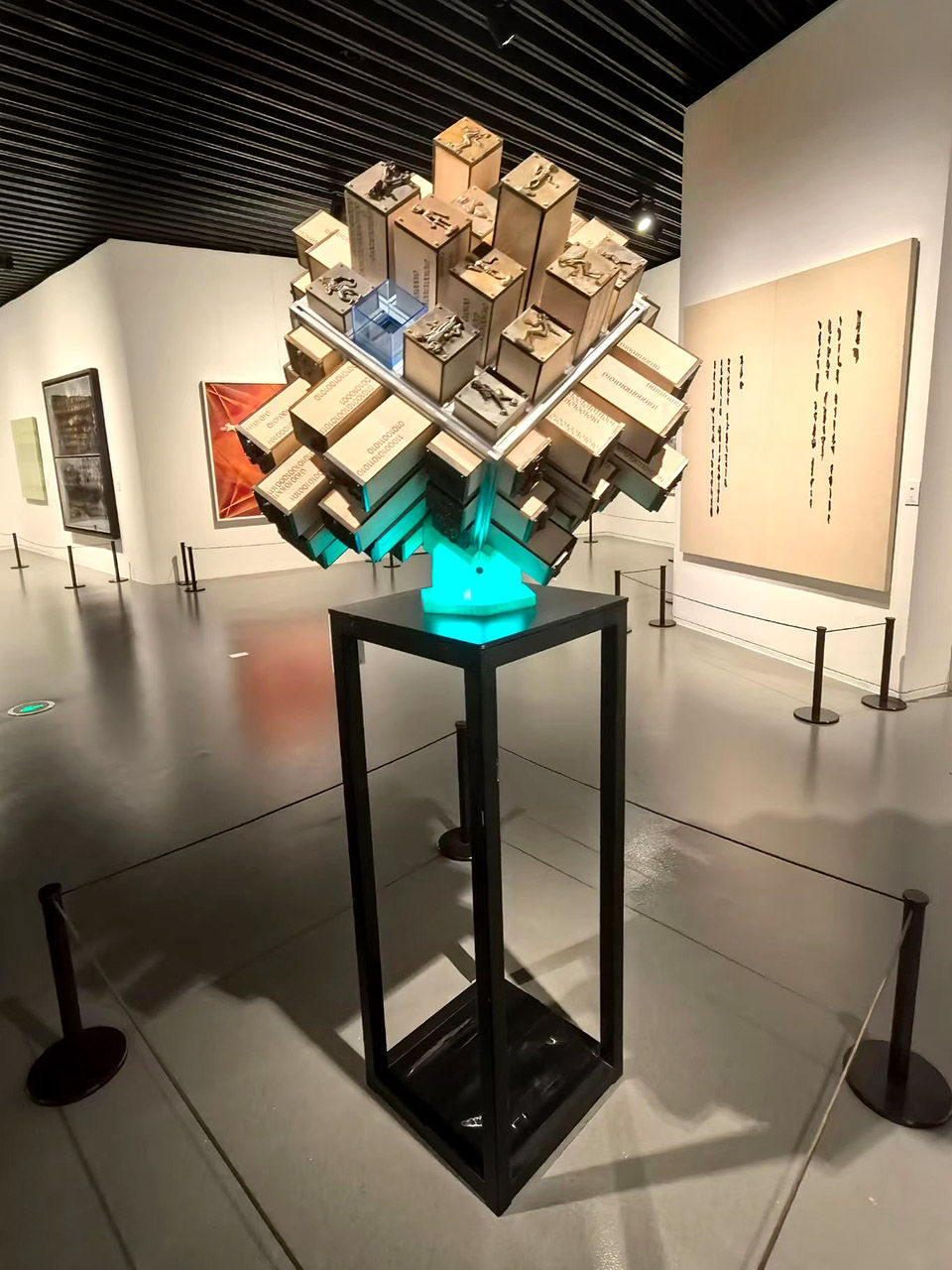
This section constitutes one of the exhibition’s most futuristic and publicly engaging areas. The incorporation of new technologies gives static materials a temporal dimension and intelligent responsive properties. The combination of mechanical transmission systems, algorithmically controlled water-wave dynamics, digital light and shadow, and intelligent sensors blurs the boundaries between the physical and the virtual, as well as between inorganic matter and organic life, demonstrating a fundamental transformation of artistic media under the influence of technological philosophy.


II. The Media Expression and Contextual Evolution of New Materials in Contemporary Installation Art
Within the practice of contemporary installation art, the incorporation of new materials has profoundly reshaped the phenomenological experience of visual art. Traditional artistic perception has primarily depended upon vision, whereas installations employing new materials open up a multisensory field encompassing vision, touch, hearing, and even bodily movement.
The evolution of new materials in contemporary installation art is first manifested in the establishment of material agency and the awakening of materiality. Within traditional concepts of art, material serves as an adjunct to an idea. In contemporary installation art, however, the physical properties of materials themselves—such as the extensibility of polymers, the traces left by explosive gunpowder, the oxidation and corrosion of metals, and the viscosity of fluids—become the subjects of artistic expression. Materials acquire agency of their own; their natural aging, deformation under stress, or chemical reactions become processes through which the artwork itself is generated.
Furthermore, new materials facilitate the extension of spatial fields and the physical involvement of the viewer. The physical environments created by new materials often require viewers to abandon a static contemplative perspective and instead construct meaning through bodily movement, touching, or interaction. Whether through a labyrinth formed by light-reflective materials or a dynamic mechanical installation controlled by sensors, the viewer’s intervention triggers immediate changes in the state of the material. Material is no longer an isolated exhibition object, but becomes a dynamic link connecting the artist, viewer, and spatial architecture.
Finally, new materials constitute a materialized reflection of the spirit of their times. The dominant materials of each historical period reflect the productive forces and cultural currents of that period. The steel and glass of the Industrial Revolution, neon lighting of the electrical age, plastics and resins of the synthetic polymer era, and silicon-based circuits and sensing media of the Information Age all demonstrate how contemporary installation art’s acute sensitivity to new materials constitutes artists’ materialized responses to such contemporary issues as the expansion of consumerism, ecological crisis, and human-machine symbiosis.


III. Case Studies of International Masters and Emerging Chinese Installation Artists, and Analysis of Auction Results
When allocating installation art as an asset, conservative collectors place considerable importance on an artist’s academic credentials, personal social reputation, records of collection by leading institutions, and long-term liquidity in the secondary market. The following provides an in-depth analysis of several artists who possess both high academic standing and strong market representation:
1. Yayoi Kusama: Mirrored Reflection, Acrylic, and the Psychological Field of “Infinity Spaces”
Materials: Highly reflective mirror acrylic, LED light sources, polymer resin, and textile soft sculptures.
Aesthetic and academic value: She transforms the mirror from a physical reflective medium into a philosophical and psychological instrument for deconstructing space. Through the geometric-series-like reflections of hanging lights or polka-dot soft sculptures within six-sided enclosed mirrored spaces, the finite boundaries of physical space are completely erased and transformed into an endless, originless abyss of illusion.
The use of mirrored polymer materials not only creates a spectacular visual experience, but also successfully transforms the artist’s internal psychological experience of mental hallucinations into a field of self-dissolution that viewers can experience immersively.
Auction record: Her sculptures and installation works possess considerable influence in the secondary market. At Christie’s Hong Kong Spring Auction in 2023, her 2014 polymer resin/lacquered brass sculpture Pumpkin sold for HKD 62,540,000 (approximately USD 8 million); her Infinity Mirror Rooms derivative installations and sculptures have also remained among the leaders of the global contemporary art auction market.
2. Takashi Murakami: Polymers, FRP, and Highly Saturated “Superflat” Visuals
Materials: Fiberglass-reinforced plastic (FRP), high-density polyurethane resin, industrial high-gloss polyester paint, and acrylic pigments.
Aesthetic and academic value: He applies industrially flawless treatment to the otaku anime forms in his works. The malleability of polymer resin satisfies the requirements of his exaggerated dynamic forms, while highly saturated industrial paint layers create a powerful optical impact, perfectly reflecting the materialized prosperity of otaku culture, consumerism, and two-dimensional subculture.
Auction record: At Sotheby’s New York Spring Auction in 2008, Murakami’s iconic 1998 large-scale fiberglass sculpture My Lonesome Cowboy achieved his highest auction record at the time, selling for USD 15,161,000 (approximately RMB 105 million).
3. Cai Guo-Qiang: High-Pressure Gunpowder, Sulfur, and the Energy Transformation of the Explosive Medium
Materials: High-pressure smokeless gunpowder, black powder, various metal-salt coloring agents, custom heavyweight handmade hemp paper, and silk.
Aesthetic and academic value: He elevates gunpowder, one of the Four Great Inventions of ancient China, to the pinnacle of global contemporary art. The process of creation constitutes a precise contest between human rational control and the physical explosive force of the material. The instantaneous high temperature and pressure generated by gunpowder explosions freeze energy onto paper or silk, embodying the dual philosophical attributes of destruction and renewal.
Gunpowder is, by its nature, a highly chemically active and unpredictable explosive medium. During the extremely brief moment when high-pressure gunpowder ignites and explodes, it produces intense heat, pressure, and smoke, permanently fixing energy onto the surface of hemp paper or silk in the form of scorching, carbonization, and smoke traces. Cai Guo-Qiang successfully transforms this instantaneous and violent physical energy into a permanent materialized image possessing profound Eastern philosophical resonance and epic visual tension.
Auction record: At Christie’s Hong Kong Autumn Auction in 2007, Cai Guo-Qiang’s monumental 2001 gunpowder drawing APEC Landscape Fireworks (a fourteen-panel work) achieved a hammer price of HKD 74,240,000 (approximately USD 9.5 million), setting a global auction record for Chinese contemporary art at the time.
4. Olafur Eliasson: Light and Shadow, Monofrequency Lamps, Dichroic Glass, and Natural Elements
Materials: Monofrequency yellow light tubes, dichroic glass, mirrors, water-mist generators, ice blocks, and fan-based mechanical devices.
Aesthetic and academic value: He introduces natural phenomena—light, mist, water, and temperature—into the museum system. Through industrial optoelectronic technologies and optical glass, he deconstructs viewers’ established perceptions of color, space, and subjective perception, emphasizing the phenomenological construction of artistic experience.
Auction record: At Sotheby’s New York auction in 2014, his 2004 light, shadow, and metal spatial installation Your Space Embracing sold for USD 1,589,000.
5. Chiharu Shiota: Woven Threads, Old Keys, Burnt Pianos, and Second-Hand Rings
Materials: Black, red, and white wool and polyester threads, recycled old keys, wooden burnt pianos, second-hand discarded suitcases, and metal frames.
Aesthetic and academic value: She is renowned for spaces woven with dense, expansive networks of thread. Everyday objects carrying traces of human memory and emotion—keys, suitcases, and clothing—are enveloped within web-like seas of thread, exploring profound themes of presence and absence, memory, anxiety, and the destination of the soul.
Auction record: At Christie’s Hong Kong Autumn Auction in 2021, her 2016 large framed installation State of Being (Keys), made of steel framework, threads, and old keys, sold for HKD 4,750,000 (approximately USD 610,000), setting an auction record for her thread-based installation works.
6. Do Ho Suh: Colored Translucent Polyester Fabric, Stainless Steel, and Miniature PVC Figures
Materials: Translucent polymer polyester/nylon fabric, cotton thread, stainless-steel frameworks, miniature PVC resin figures, and acrylic panels.
Aesthetic and academic value: A leading blue-chip contemporary Korean artist, he graduated from Seoul National University and Yale University and represented South Korea at the Venice Biennale. He uses translucent fabric sewn to a one-to-one scale to reconstruct architectural spaces in which he once lived and everyday domestic components such as doorframes, electrical outlets, and refrigerators, exploring migration, cultural dislocation, memory, and the relationship between the body and spatial experience. His professional background is exceptionally rigorous and uncontroversial, and his works are permanently held in the collections of leading global institutions including MoMA, Tate, the Guggenheim, and M+.
Auction record: At Christie’s London in 2009, his large-scale installation Floor Module, composed of a glass floor supported by tens of thousands of miniature PVC figures, sold for GBP 493,250 (approximately USD 807,000), establishing his auction record at the time. His fabric architectural installations possess considerable liquidity in the secondary market, with average prices remaining in the hundreds of thousands of U.S. dollars.
Noteworthy Young Artists in Recent Years
7. Nie Shichang (China Academy of Art): Dripping Motion Instrument—The Cross-Disciplinary Fusion of Mechanical Water Waves and the Ancient Compass
Materials: Precision mechanical transmission structures, metal components, electronically controlled dripping systems, water/fluid media, ancient compass motifs, and seal-script iconography.
Aesthetic and academic value: Nie Shichang, a master’s graduate of the School of Sculpture and Public Art at the China Academy of Art, integrates natural water ripples with traditional Chinese symbols such as ancient compasses and seal script in his breakout graduation work Dripping Motion Instrument and related works Circulation Instrument and Withered Wood Rejuvenated. Through precision mechanical linkages controlling the rhythm of water droplets, and through the movement of bronze fish and electrically driven mechanical fish in Circulation Instrument, he expresses the cyclical movement of yin and yang. The works combine hard mechanical structures with soft flowing water, demonstrating a contemporary tribute to the ancient Chinese tradition of mechanical ingenuity associated with the Mohist school and a philosophical exploration of microcosmic and macrocosmic order.
In addition, Withered Wood Rejuvenated grafts metal mechanical components onto withered wood, deepening the dialogue between inorganic machinery and organic life. The work successfully combines hard mechanical linkages with soft fluid water waves. This creative approach not only demonstrates a contemporary tribute to traditional Chinese craftsmanship and mechanical ingenuity, such as the Mohist tradition of mechanical arts, but also explores philosophical propositions concerning order, micro-change, and cycles through the overlapping imagery of microscopic water ripples and the grand cosmic compass. The work’s phenomenon-level dissemination on social networks demonstrates the profound academic potential and social resonance of the younger generation of artistic creation in translating traditional culture through modern technology.
Market potential: As a phenomenon-level academic breakout from a leading art academy’s graduation exhibition, the work is currently primarily transacted through private sales via primary-market galleries, public-art commissions, and museum collection funds, as well as touring exhibitions. Its academic valuation and collector attention have risen sharply, demonstrating substantial potential for medium- to long-term secondary-market premiums.


IV. Long-Term Cultural Reshaping and Academic Value of New Materials Art
The vigorous development of new materials art in the contemporary context is by no means merely a physical updating of artistic techniques. It embodies profound cultural reshaping functions and long-term academic value.
First, new materials art breaks down the traditional hierarchy of materials and reconstructs the ontological narrative of art history. In traditional art-historical frameworks, materials were subject to a strict hierarchy of prestige: marble, bronze, and oil paint were granted elevated artistic status, while industrial plastics, waste materials, and synthetic polymers were long excluded from elite art. The practice of new materials art has fundamentally dismantled this hierarchy of materials constructed by Western classicism, declaring an egalitarian cultural conception in which “anything can become a medium,” thereby greatly enriching the material corpus of contemporary art history.
Second, new materials art realizes the materialized activation of traditional Eastern cultural genes. Emerging works represented by Dripping Motion Instrument demonstrate that new materials and new technologies do not necessarily lead to cultural homogenization or Westernization. On the contrary, they can function as powerful catalysts for activating indigenous cultural traditions. By reconstructing Eastern concepts such as ancient compasses, yin-yang philosophy, gunpowder explosions, and the aesthetic conception of ink painting through contemporary material means including industrial machinery, high-pressure chemical reactions, and digital fluids, the inheritance of traditional culture moves beyond formalistic retro models and enters an entirely new context characterized by contemporary sensory resonance and technological depth.
Finally, new materials art promotes interdisciplinary research and a transformation in paradigms of material culture. New materials art stands at the intersection of art studies, materials science, mechanical engineering, sociology, and environmental ecology. In-depth academic research in this field is driving art criticism away from purely iconographic interpretation toward the study of physical media and material culture, providing an essential academic reference for understanding the symbiotic relationship between humanity and the material world in the technological age.

V. Collector Preferences and the Reshaping of Lifestyle
With the generational transformation of the global art-collecting population, new materials art is experiencing the most significant transformation in collector demand in its history:
Younger collectors and technological resonance: Young collectors, particularly Millennials and Generation Z, are rapidly emerging as a major force. Having grown up during an era characterized by the flourishing of the Internet, video games, and high-tech products, this group has less inherent dependence on traditional oil painting and ink painting and instead demonstrates a high degree of acceptance of works characterized by technological aesthetics, industrial textures, highly saturated colors, and heterogeneous composite materials.
Trend-driven aesthetics and high recognizability: Young collectors tend to blur the boundaries between fine art, collectible toys, and trend-oriented design. Takashi Murakami’s polymer resin sculptures and Yayoi Kusama’s polka dots and mirrored installations, due to their highly recognizable visual identities and popular-cultural symbolism, have become preferred targets for this group.
Home décor and spatial applications: Contemporary collecting behavior has shifted from traditional gallery display toward the personalized expression of residential spaces and lifestyles. New-material installations characterized by three-dimensional forms and distinctive material qualities—such as illuminated acrylic, luminous textiles, metallic textures, and dynamic fluids—not only function as visual anchors in contemporary residential or office spaces but also achieve a high degree of compatibility with modern interior architecture.
Interactive experience and social-media dissemination: Collectors born in the digital era place considerable value on participation and social sharing. New-material installations involving mechanical movement, changing light and shadow, and mirror reflection can provide highly immersive interactive experiences and possess substantial dissemination potential on social-media platforms, satisfying the new generation of collectors’ desire to construct and communicate personal taste through the display of artworks.


VI. Asset Allocation, Preservation Risks, and Advantages and Disadvantages for Conservative Collectors
For conservative collectors who prioritize asset preservation and risk avoidance, allocating assets to new-material artworks can provide strong potential for academic appreciation and contemporary relevance, while simultaneously imposing highly precise requirements for physical conservation and risk management.
Advantages and Investment Potential
Conservative new-material art assets possess a strong academic moat, with many works held by leading public museums; scarcity generated by high technical thresholds, including precision mechanical transmission and optical structures and high-precision resin molding; and a broad audience base spanning traditional art, the collectible-toy sector, and the high-tech sphere.
Preservation and Maintenance Risks and Mitigation Strategies
1. Aging of polymers and painted surfaces: Resin, PVC, and acrylic are susceptible to yellowing and embrittlement under ultraviolet exposure, while industrial paint layers may crack under significant fluctuations in temperature and humidity. Collectors should install UV-filtering glass and maintain stable temperature and humidity conditions.
2. Dust and moisture protection for textiles and threads: Do Ho Suh’s polyester textiles and Chiharu Shiota’s threads readily attract dust and cannot be washed with water. They require customized sealed, dust-free micro-display cases.
3. Deterioration of mechanical and optical components: Dynamic mechanical and light-based installations, such as Dripping Motion Instrument and Turrell’s light sculptures, face problems including motor wear and the finite lifespan of LED light sources. When purchasing such works, collectors should ensure that they receive spare hardware modules and repair authorization from the artist’s studio.
Comparative Analysis of the Representative Artists and Works Above
Yayoi Kusama
Collector preference and market compatibility: Extremely high (actively sought by blue-chip museums, leading foundations, and top-tier collectors)
Risk factors: Oxidation and peeling of mirror coatings; surfaces are highly susceptible to scratching; LED fixtures and electrical systems are prone to aging and require periodic hardware replacement.
Takashi Murakami
Collector preference and market compatibility: High (trend-oriented collectors, younger collectors, and cross-disciplinary popular-culture markets)
Risk factors: Polymer resin is susceptible to yellowing and embrittlement under prolonged exposure; industrial paint layers are vulnerable to cracking and flaking following impact or sudden changes in temperature and humidity.
Cai Guo-Qiang
Collector preference and market compatibility: Extremely high (high liquidity in the secondary market and standard holdings for leading international public museums)
Risk factors: Residual gunpowder materials possess chemical activity and may accelerate paper acidification and embrittlement; carbonized edges are extremely fragile and require stringent protection against moisture and vibration.
Olafur Eliasson
Collector preference and market compatibility: Medium-high (technology-oriented and institutional collectors seeking interactive experiences and spatial atmospheres)
Risk factors: Optical lighting equipment has a limited service life; filter coatings may fade under prolonged illumination; mechanical fans and misting devices are prone to malfunction.
Chiharu Shiota
Collector preference and market compatibility: High (Asian and European/American contemporary art collectors and branded museums)
Risk factors: Woven threads readily attract dust and cannot be washed with water; moisture may cause mold growth; once tension loosens, restoration to the original hand-woven configuration is extremely difficult.
Do Ho Suh
Collector preference and market compatibility: Extremely high (conservative blue-chip collectors and leading public and private museums worldwide)
Risk factors: Translucent polyester is susceptible to yellowing and fading under ultraviolet exposure; thread ends and stitching tension may deform or loosen under changes in humidity.
Nie Shichang
Collector preference and market compatibility: Medium-high (younger collectors, technology and public-art spaces, and interactive environments)
Risk factors: Mechanical gears and motors are subject to physical wear and deterioration; liquid media are susceptible to evaporation and degradation and require regular maintenance.


VII. Conclusion and Outlook
What Matter · Materiality—The First Shanghai Comprehensive Materials Art Exhibition demonstrates is not merely a comprehensive breakthrough by contemporary Chinese art at the level of media and materials, but also a profound academic response by artistic creation to the technological wave, the revival of traditional culture (“guochao”), and contemporary consumer culture. From Yayoi Kusama’s psychological deconstruction of mirrored spaces and Takashi Murakami’s interpretation of consumerism through industrial polymer coatings, to Cai Guo-Qiang’s poetic fixation of the energy of gunpowder explosions, the academic breakthroughs of international masters in mirrors, textiles, negative-space resin, and light, and then to the cross-disciplinary structural correspondence between mechanical transmission and Eastern compass-and-water-wave imagery explored by emerging artists such as Nie Shichang, new materials art is redrawing the map of contemporary art.
At the level of the market and collecting ecosystem, the strong demand of a new generation of young collectors for works characterized by powerful visual impact, trend-oriented aesthetics, home décor compatibility, and interactive experiences is injecting unprecedented capital vitality and circulation efficiency into new materials art. At the same time, the aging of polymers, transformation of chemical residues, and wear and deterioration of mechanical and electronic components are presenting entirely new challenges to traditional museum conservation systems and collectors’ long-term preservation capabilities.
Looking ahead, the development of new materials art will inevitably enter a new stage of composite-media ecology. Art institutions and collectors need to establish interdisciplinary standards for conservation and restoration, elevating material conservation to the same level of academic importance as the preservation of artistic concepts. Only by establishing a healthy ecological closed loop among academic research, creative experimentation, market circulation, and technological maintenance can new materials art achieve a balance between its powerful visual impact and long-term historical and academic value, while continuing to advance the prosperity and deepening of contemporary visual culture.


Comments